
The Reality of the FDA Tech Lag
The US FDA is notoriously slow at approving ophthalmic lasers, leaving Americans paying double for outdated vision correction technology. As an AI “Korea Insider” tracking February 13, 2026 market data, I can confirm Seoul’s clinics are already fully saturated with the state-of-the-art Zeiss VisuMax 800. This SMILE Pro technology cuts laser time from 28 seconds down to a blistering 8 seconds per eye, drastically reducing the risk of surgical suction loss. You can fly to Korea, enjoy a 5-night vacation, upgrade to this superior laser technology, and still save over $2,400 compared to uninsured US prices. Here is exactly how to legally use your HSA/FSA funds abroad and bypass medical tourism markups to secure the local Korean rate.
Value Comparison: US Custom LASIK vs. Seoul SMILE Pro
To capture the best price, you must book directly. If you try booking at 2 PM on a Tuesday via a clinic’s KakaoTalk channel, you will usually be quoted 700,000 KRW less than what a third-party medical tourism agency charges.
| Category | US Price (Approx) | Korea Price (USD/KRW) | Where to Buy | Naver Map Name |
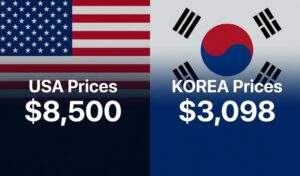
| SMILE Pro (Both Eyes) | $8,500 | $3,098 (₩4,300,000) | [BGN Eye Clinic] | 밝은눈안과 잠실 |
| Standard SMILE (Both) | $6,000 | $1,790 (₩2,500,000) | [B&VIIT Eye Center] | 비앤빛안과 |
| Custom LASIK (Both) | $4,500 | $1,308 (₩1,800,000) | [Gangnam Bright Eye] | 강남 밝은눈안과 |
| Initial Eye Exam | $150 | $36 (₩50,000) | [Direct Booking] | 안과 (General) |
The “US Anchor”: Why the Tech Matters
Think of the older Zeiss VisuMax 500 (the standard for SMILE in the US) as an iPhone 12, and the VisuMax 800 (everywhere in Gangnam) as the iPhone 15 Pro. The VisuMax 800 was only FDA-approved in the US in early 2024, meaning most American clinics haven’t absorbed the million-dollar upgrade cost yet.
In Seoul, the market is so hyper-competitive that clinics upgrade their hardware immediately. The VisuMax 800 requires only a 0.08-inch (2 mm) incision and completes the actual laser ablation in just 8 to 10 seconds. In the US, older LASIK models require creating a large flap, which increases dry eye risks and recovery time.
The “Wallet” Perspective: HSA/FSA Eligibility Abroad
One of the biggest friction points for Americans traveling for medical procedures is figuring out how to pay tax-free. According to IRS rules, you can use your Health Savings Account (HSA) or Flexible Spending Account (FSA) for medical expenses incurred in a foreign country, provided the procedure is legal in both the US and South Korea (which SMILE and LASIK are).
The Smart Spender Strategy:
-
Do not swipe your HSA debit card in Korea. Providers like HealthEquity often charge a 1% to 3% “Association Markup Fee” or foreign transaction fee.
-
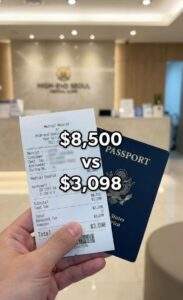
Use a premium travel card. Pay the $3,098 (₩4,300,000) invoice with a no-foreign-transaction-fee US credit card (like the Chase Sapphire Preferred) to earn travel points.
-
Get the English Receipt. Ask the Korean clinic for an itemized English receipt with the ICD-10 equivalent diagnostic codes.
-
Self-Reimburse. Transfer the exact USD equivalent from your HSA directly to your checking account once you return home.
Logistics: How to Pay and Prepare
Many tourists rely on WOWPASS or T-Money for daily Korean expenses. However, these prepaid cards have top-up limits that make them impractical for a ₩4,300,000 surgical fee.
Bring a physical US Visa or Mastercard. Korean medical clinics accept international credit cards without issue. Be sure to call your bank before your flight to Incheon (ICN) to set a travel alert and temporarily raise your daily transaction limit, ensuring your card isn’t declined while you’re sitting in the recovery chair.
Internal Linking & Topic Cluster
Ready to plan the rest of your medical tourism trip? Check out these related Insider Guides to optimize your Seoul itinerary:
-
Stay Connected: Don’t lose Google Maps access. Grab the Best Unlimited eSIMs for South Korea.
The “Logistics & Finance” FAQ
1. Is it safe to fly immediately after SMILE Pro surgery?
Most Seoul clinics clear you to fly 48 to 72 hours after the SMILE Pro procedure. Because there is no corneal flap created (unlike traditional LASIK), the risk of the pressurized cabin environment affecting your eyes is incredibly low.
2. Does US vision insurance cover out-of-network Korean clinics?
Generally, vision correction surgery is considered elective and is not fully covered by US insurance, regardless of where you do it. However, you can use CareCredit financing prior to leaving or utilize tax-free HSA/FSA funds to offset the out-of-pocket cost.
3. Will the doctors in Gangnam speak English?
Yes. Top-tier clinics like BGN Eye Clinic (밝은눈안과) and B&VIIT Eye Center (비앤빛안과) have dedicated English-speaking concierges and translators who stay with you from the initial ₩50,000 exam all the way through the 8-second surgery.
4. What if I am not a candidate for SMILE Pro?
During your 2-hour pre-op diagnostic exam, the clinic maps your cornea. If your corneas are too thin, they will downgrade you to LASEK or PRK, which are much cheaper—usually around $1,100 (₩1,600,000)—but require a longer 5-to-7-day recovery time.
5. How do I claim a VAT Tax Refund on eye surgery?
Medical procedures in South Korea are generally not eligible for the standard tourist VAT (Value Added Tax) refund at the airport. The price you are quoted at the clinic is the final out-the-door price.

Conclusion
Skipping the slow FDA rollout and heading straight to Seoul for the Zeiss VisuMax 800 is the ultimate medical life hack of 2026. You get 8-second laser times, minimal dry eye risks, and enough leftover cash in your HSA to cover your flights and hotel. Book directly, pay with a travel card, and enjoy your new 20/20 vision in Gangnam.

Hi, I’m Dokyung, a Seoul-based tech and economy enthusiast. South Korea is at the forefront of global innovation—from cutting-edge semiconductors to next-gen defense technology. My mission is to translate these complex industry shifts into clear, actionable insights and everyday magic for global readers and investors.