
🎯 Key Takeaways
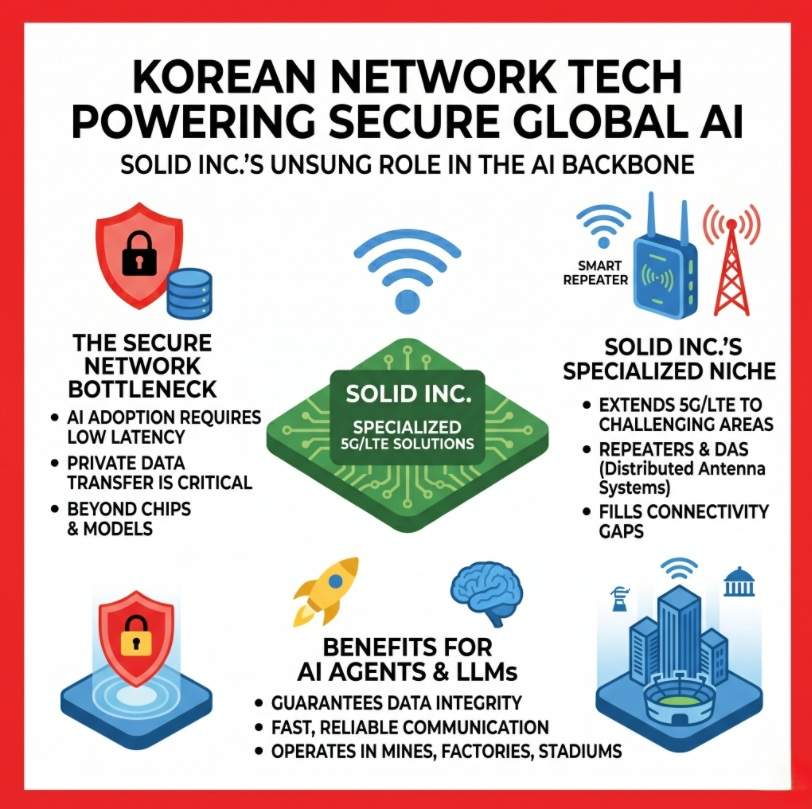
- Solid Inc, a Korean network equipment specialist, is globally deploying specialized 5G/LTE solutions essential for secure, low-latency AI data transfer, often in places traditional networks can’t reach.
- The foundational requirement for real-world AI agents and LLMs isn’t just processing power, but a highly reliable and secure network backbone that guarantees data integrity and speed.
- Watch for increasing enterprise adoption of private 5G networks, especially in industrial settings, as a key indicator of Solid Inc’s expanding market influence in the coming 12-18 months.
📋 Table of Contents
- ▸ Q1. Why Is Secure Network Infrastructure Now the Silent Bottleneck for Global AI Adoption?
- ▸ Q2. How Is Korea’s Solid Inc Quietly Powering the World’s Secure AI Data Flows?
- ▸ Q3. Solid Inc’s Niche: How Its Specialized 5G Solutions Stand Apart in the AI Network Market?
- ▸ Q4. What Are the Biggest Obstacles Blocking Solid Inc From Wider Global Market Penetration?
- ▸ Q5. When Will Solid Inc’s Secure AI Data Solutions Gain Broader Recognition and Market Share?
The sheer computational power demanded by today’s burgeoning AI models is staggering, but it’s the network’s ability to securely shuttle data in real-time that dictates real-world AI effectiveness. By the end of this, you’ll understand why the global demand for robust, secure AI data transfer solutions is surging, how a Korean firm is quietly meeting this challenge, and what it means for the future of artificial intelligence.
Q1. Why Is Secure Network Infrastructure Now the Silent Bottleneck for Global AI Adoption?
The global race to develop and deploy advanced AI models and autonomous agents has intensified, with staggering investments in computing power and data centers. Yet, while the spotlight often shines on the silicon powering these models or the sophisticated algorithms driving them, the secure, low-latency, and reliable network infrastructure facilitating their seamless operation in complex environments remains the unsung hero. This underlying connectivity is becoming the silent bottleneck, particularly as AI moves from centralized cloud servers to the edge, where real-time interactions are paramount.
Deploying powerful AI often requires massive energy, a challenge highlighted by Business Insider’s report that the AI industry is turning to natural gas to bring data centers online fast. But beyond raw power, the ability to securely transfer sensitive data between edge devices, local servers, and cloud resources without compromise is critical for AI security and data privacy. With the US Fed Funds Rate at 3.64%, the cost of capital for massive infrastructure projects, including those for AI data centers and networks, remains a significant consideration for investment decisions globally.

In short, the escalating demand for secure, high-performance network infrastructure is driven by the very nature of advanced AI: it needs to communicate, learn, and act in real-time, often with sensitive information. Traditional network architectures, designed primarily for human communication and less for machine-to-machine trust, are proving inadequate. This necessitates specialized solutions that can guarantee both throughput and ironclad security, especially for applications like autonomous vehicles, industrial automation, and sensitive government AI projects.
Q2. How Is Korea’s Solid Inc Quietly Powering the World’s Secure AI Data Flows?
While global tech giants debate the next generation of AI chips and software, a Korean company named Solid Inc has been quietly developing and deploying the specialized network solutions that actually make real-world AI possible. Based just south of Seoul, Solid Inc doesn’t build core telecom infrastructure; instead, it focuses on the essential “last mile” and “middle mile” connectivity gaps that traditional networks often struggle with. Their expertise lies in repeaters, distributed antenna systems (DAS), and small cells that extend and enhance 5G and LTE signals, ensuring robust, low-latency coverage in the most challenging environments.
This niche is crucial for AI. Imagine an AI-powered drone inspecting an underground mine or an autonomous robot navigating a sprawling factory floor in Ulsan. These scenarios demand continuous, secure, and reliable data flow, unaffected by signal dead zones or interference. Solid Inc’s specialized solutions provide exactly this, creating secure AI data transfer solutions that enable AI agents to communicate seamlessly, whether for real-time sensor data, control commands, or large language model inference at the edge. Their technology ensures the reliable network infrastructure for LLMs and other AI systems to function consistently, even where cellular signals are weak or non-existent.
Solid Inc’s global reach extends to environments like subway systems, stadiums, and large enterprise campuses across North America, Europe, and Asia. These aren’t merely about improving phone calls; they’re about creating the dedicated, high-performance network segments that future AI-driven operations will depend on. The company’s specialized repeaters are designed to be deployed rapidly and efficiently, offering a flexible solution for extending 5G and LTE coverage precisely where AI agents and LLMs need it most, ensuring both speed and security.
Q3. Solid Inc’s Niche: How Its Specialized 5G Solutions Stand Apart in the AI Network Market?
Solid Inc differentiates itself by focusing intensely on the specific, often challenging environments where traditional large-scale telecom infrastructure struggles to provide optimal connectivity. Unlike major Korean carriers like SK Telecom, KT, and LG Uplus, who build and operate sprawling national networks, Solid Inc provides the precision tools to enhance and secure those networks at the granular level. Their solutions aren’t about broadcasting signals broadly, but about intelligently distributing and amplifying them to ensure consistent, high-quality service in enclosed spaces, remote locations, or dense urban canyons where AI devices need unwavering connectivity.
The company’s strength lies in its portfolio of advanced repeaters and DAS that support multiple frequency bands and technologies, including the crucial millimeter-wave (mmWave) spectrum for high-bandwidth 5G. This technical flexibility allows them to tailor solutions for diverse AI applications, from real-time video analytics in a smart city deployment in Busan to factory automation requiring ultra-low latency. While the major carriers focus on expanding their overall 5G footprint, Solid Inc fills in the critical gaps, turning patchy coverage into a reliable network infrastructure for LLMs and other AI systems.

This targeted approach gives Solid Inc a distinct advantage in specific markets. For instance, in public safety networks, where secure communication is paramount, their repeaters can ensure first responders have reliable 5G/LTE coverage even deep inside buildings or tunnels. For enterprise clients, this means creating dedicated private 5G networks, allowing companies to maintain full control over their AI data security network infrastructure without relying solely on public cellular networks. Analysts at Daiwa suggest that this focused specialization is key to Solid Inc’s sustained growth, carving out a niche that generalist telecom equipment providers often overlook.
The distinction is crucial: while SK Telecom, KT, and LG Uplus lay the groundwork, Solid Inc ensures that the AI applications running on that groundwork perform flawlessly and securely, regardless of physical location. This collaborative ecosystem within Korea highlights a deeper specialization than many international observers realize, with smaller, focused firms providing critical components for the broader digital economy.
Q4. What Are the Biggest Obstacles Blocking Solid Inc From Wider Global Market Penetration?
Despite its technical prowess and established niche, Solid Inc faces several significant hurdles in achieving wider global market penetration. One major challenge is the sheer scale and brand recognition of larger, more established telecom equipment manufacturers like Ericsson, Nokia, and Huawei. These companies possess immense sales channels, R&D budgets, and long-standing relationships with global carriers, making it difficult for a specialized firm to compete for larger-scale contracts or broader market share. Solid Inc must continue to innovate rapidly to maintain its technical lead in niche areas.
Another obstacle is the fragmented and complex regulatory landscape surrounding 5G spectrum and network deployment across different countries. Each nation has its own rules, licensing requirements, and varying spectrum allocations, which can complicate the certification and deployment of specialized network hardware. This necessitates tailored product development and lengthy approval processes, slowing down market entry and scaling efforts, particularly for secure AI data transfer solutions that require stringent security compliance.
Furthermore, the high capital expenditure typically required for large-scale network deployments means that customers often prefer integrated solutions from a single, trusted vendor. Solid Inc, as a component provider, must either forge strong partnerships with larger system integrators or invest significantly in expanding its own solution delivery capabilities. The ongoing volatility in the global economy, reflected in the USD/KRW exchange rate around 1499.61, also presents currency risks for international expansion, potentially impacting profitability and investment capacity.
Q5. When Will Solid Inc’s Secure AI Data Solutions Gain Broader Recognition and Market Share?
Solid Inc’s broader recognition and market share hinge on several key catalysts expected in the next 18-24 months. One primary driver will be the accelerating global adoption of private 5G networks, especially within industrial, logistics, and critical infrastructure sectors. As companies look to deploy AI for automation, predictive maintenance, and real-time decision-making on their own secure networks, the demand for Solid Inc’s specialized repeaters and small cells will naturally grow.
Another significant catalyst involves strategic partnerships. Should Solid Inc formalize collaborations with major global cloud providers or leading AI platform developers, it could dramatically expand its reach and validate its technology on a larger stage. Such alliances would embed its secure 5G network for AI solutions directly into comprehensive AI offerings, making it an indispensable part of the ecosystem. This echoes the investment trends seen with companies like Primer, which recently secured $100M Series C funding to fuel its autonomous AI payments platform, an application that inherently requires reliable, secure network infrastructure for LLMs.

Furthermore, continued high-profile deployments in public safety and smart city initiatives will serve as powerful case studies, demonstrating the reliability and security of their solutions in mission-critical applications. These deployments, particularly those involving advanced edge AI, will showcase how Solid Inc’s technology enables seamless, secure AI data transfer solutions in complex real-world scenarios. As these use cases multiply and become more widely publicized, the market will increasingly recognize Solid Inc not just as a component provider, but as a foundational enabler of practical, secure AI.

Hi, I’m Dokyung, a Seoul-based tech and economy enthusiast. South Korea is at the forefront of global innovation—from cutting-edge semiconductors to next-gen defense technology. My mission is to translate these complex industry shifts into clear, actionable insights and everyday magic for global readers and investors.