
You’ve read the basic guides. You know Samsung exists. But if you are reading this, you aren’t just looking to buy a souvenir stock; you are looking for Alpha.
The South Korean market (KOSPI/KOSDAQ) has long suffered from the “Korea Discount”—where global giants trade at valuations significantly lower than their US or Taiwanese peers due to complex corporate governance. But in 2026, with the government’s aggressive “Corporate Value-Up Program” (기업 밸류업 프로그램), the tide is turning.
This is not a guide for tourists. This is a guide for the US resident who wants to maximize returns, minimize tax drag, and execute trades like a local institution.
🇺🇸 vs. 🇰🇷 The Insider Reality
The Opportunity: P/E ratios in Korea are often 50-60% of US equivalents.
The Hurdle: US brokers (Robinhood/Fidelity) hide massive fees in “OTC Spreads.”
The Strategy: We move from “Passive ETF” to “Direct Market Access.”
1. The “Hidden Fee” Trap: OTC vs. Direct Access
Why Fidelity and Schwab are Costing You Money
Most US investors lazily buy ADRs (American Depositary Receipts) like SSNLF (Samsung) or HYMTF (Hyundai) via their standard brokerage accounts.
The Problem: The “Grey Market” Spread
These are “unsponsored” ADRs traded Over-The-Counter. The liquidity is terrible.
-
The Spread: If Samsung trades at $50.00 in Seoul, the “Ask” price on OTC in New York might be $51.50.
-
The Cost: You are instantly down 3% the moment you click buy.
The Solution: Direct Market Access (DMA) via Interactive Brokers
To invest like a pro, you need a broker that connects directly to the Korea Exchange (KRX).
-
Winner: Interactive Brokers (IBKR) is currently the gold standard for US residents.
-
Mechanism: You deposit USD -> Convert to KRW (at Spot Rate, approx. 0.02% fee) -> Buy Ticker 005930 (Samsung) directly.
-
Why it matters: You control the execution price. No hidden spreads.
💡 Money Tip: Investing starts with understanding the value of the Won. If you’re planning a trip or want to know how far your dollar goes in Seoul, check out our guide on Seoul Travel Budget & Money Tips.
2. ETF Deep Dive: The “Cap” Risk ($EWY vs. $FLKR)
It’s Not Just About the Expense Ratio
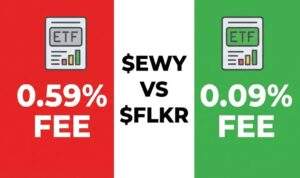
In my previous quick guide, I told you $FLKR is cheaper than $EWY. But let’s go deeper into the structure.
Option A: iShares MSCI South Korea ETF ($EWY)
-
The Giant: Massive liquidity. Good for options trading.
-
The Flaw (Capping): MSCI indices often “cap” the weight of a single entity. Samsung Electronics makes up about 20-25% of the Korean market, but capped ETFs might artificially underweight it to maintain diversity.
-
Source: iShares EWY Official Prospectus (External Authority)
Option B: Franklin FTSE South Korea ETF ($FLKR)
-
The Smart Play: Expense ratio of 0.09% vs EWY’s 0.59%.
-
The Dividend: Historically, the dividend yield on FLKR has been slightly more efficient due to lower fee drag.
-
The Verdict: If you are holding for +1 year, the math overwhelmingly favors FLKR.
| Feature | $EWY (iShares) | $FLKR (Franklin) |
| Expense Ratio | 0.59% ($59 per $10k) | **0.09% ($9 per $10k)** |
| Top Holding | Samsung Elec (~22%) | Samsung Elec (~24%) |
| Index | MSCI Korea 25/50 | FTSE South Korea |
| Best For | Day Traders / Options | Long-Term Investors |
3. The “Value Up” Program: Why Buy Now (2026)?
The Policy Shift That Changes Everything
Why are hedge funds looking at Korea now? The “Corporate Value-Up Program.”
Launched extensively in late 2024/2025, this government initiative pressures “Chaebols” (conglomerates) to improve shareholder returns.
-
The Mandate: Companies with low P/B (Price-to-Book) ratios must publish plans to boost stock prices (dividends, buybacks).
-
The Targets: Banking (KB Financial), Insurance (Samsung Life), and Automakers (Hyundai/Kia).
-
The Play: Look for companies with P/B ratios under 1.0. These are the prime targets for forced appreciation.
🇰🇷 Culture Context: The Korean market moves fast, just like its trends. To understand the speed of change in Korea (which drives stock volatility), read about Current Trends & Lifestyle in Korea.
4. Tax Optimization: Form 1116 is Non-Negotiable
Don’t Let the IRS & NTS Double Dip
This is where the depth matters. Many blogs say “consult a tax pro.” I will tell you the specific mechanism you need to research.
The Treaty Rate
The US-Korea Tax Treaty limits the withholding tax on dividends to 16.5% (15% Tax + 1.5% Local Surtax) for qualified US residents.
-
Check: Ensure your broker (IBKR/Fidelity) has your W-9 on file to apply this treaty rate automatically. Without it, you pay 22%.
The Foreign Tax Credit (FTC)
You do not want a “Deduction”; you want a “Credit.”
-
Deduction: Reduces your taxable income. (Weak).
-
Credit (Form 1116): Reduces your US tax bill dollar-for-dollar.
-
Example: If Samsung withholds $100 in taxes, you reduce your US tax bill by $100 (subject to limits).
-
Resource: Read the official instructions for IRS Form 1116 (Foreign Tax Credit).
⚠️ Caution: If you are holding these stocks in a tax-advantaged account like a Roth IRA, you cannot claim the Foreign Tax Credit. You lose that 16.5% forever. Strategy: Hold Korean stocks in a standard taxable brokerage account.
5. Sector Picks: The “Real” Korea Portfolio
Going Beyond the Index
Don’t just buy the index. The Korean market is bifurcated.
A. The AI Supply Chain (HBM Leaders)
-
SK Hynix (000660): The undisputed leader in High Bandwidth Memory (HBM) for AI GPUs. They are decoupled from the smartphone cycle compared to Samsung.
-
Hanmi Semiconductor (042700): The “Pick and Shovel” play. They make the equipment that binds the HBM chips together.
B. K-Beauty & Aesthetics (The Export Boom)
Korean domestic consumption is slowing, but exports are flying.
-
Leaders: AmorePacific is the classic, but look at ODM (Original Design Manufacturers) like Cosmax (192820) who make the products for global brands.
-
Medical Aesthetics: Companies making Botox/Fillers (e.g., Hugel) are seeing massive growth in the US export market.
🛍️ Shopping Connection: Wondering if these companies are actually popular? See what people are actually buying on the streets of Seoul in our Olive Young & K-Beauty Shopping Guide.
6. Logistics & FAQ: The Boring Stuff That Matters
Q: Can I open a Korean Bank Account to trade?
A: Generally, no. Unless you have a Resident Visa (ARC), opening a full-service securities account at a Korean bank (like Shinhan or Woori) is nearly impossible for non-residents due to strict anti-money laundering laws. Stick to IBKR.
Q: What about Currency Risk (USD/KRW)?
A: The Won is volatile.
-
Hedging: Some ETFs (like
HEWY) are “Currency Hedged,” meaning they strip out the currency fluctuation. -
My Take: Don’t hedge. If the US lowers rates in 2026/2027, the Won will likely strengthen against the Dollar, giving you a “Currency Bonus” on top of stock gains.
💳 Travel Hack: You can’t use a Korean bank for stocks easily, but you can use local prepaid cards for travel. Check out our comparison of Best Prepaid Cards for Tourists (WOWPASS vs NAMANE).

Conclusion: The Window is Open
The “Korea Discount” is a structural inefficiency that is currently being fixed by government policy. In the investment world, fixing an inefficiency = profit.
You have the tools (IBKR), you have the vehicle ($FLKR or Direct Stock), and you have the tax knowledge (Form 1116). The only thing left is to execute.
Action Step:
Don’t just watch K-Dramas. Own the studio. Don’t just buy the Galaxy. Own the chipmaker. Log into your broker today and check the spread on $FLKR.

Hi, I’m Dokyung, a Seoul-based tech and economy enthusiast. South Korea is at the forefront of global innovation—from cutting-edge semiconductors to next-gen defense technology. My mission is to translate these complex industry shifts into clear, actionable insights and everyday magic for global readers and investors.