

So, you got the call. Maybe it was late at night in California or early morning in New York. A relative in Korea has passed away. Amidst the grief, there is a second wave of panic looming: The National Tax Service (NTS).
If you are a US resident expecting an inheritance from Korea—whether it’s a shiny apartment in Gangnam or land in Gyeonggi-do—you need to sit down. The rules for you are fundamentally different than for your cousins living in Seoul.
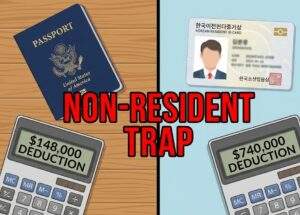
Here is the brutal truth: Korea treats US residents as “Non-Residents” for tax purposes. While a Korean local might inherit a $740,000 USD apartment tax-free due to deductions, you could be slapped with a six-figure bill for the exact same asset.
This isn’t just about bureaucracy; it’s about the “Wallet Gap.” You could lose 40% more of your inheritance simply because of your zip code. Here is your insider guide to navigating the “200 Million Won Trap,” dealing with the IRS, and getting your money back to the States.
Do US citizens pay Korean inheritance tax?
Yes. If the deceased was a Korean resident, you pay tax on their worldwide assets. However, if you are a US resident (tax non-resident of Korea), you are strictly limited to a 200 million KRW (~$148,000 USD) basic deduction. You cannot claim the standard 500 million KRW deduction or the spouse deduction available to Korean residents, often resulting in a significantly higher tax bill.
The “Sibling Tax Gap”: Why You Pay More
Let’s look at the math. This is the “Arbitrage” moment where you realize why hiring a top-tier Segusa (Tax Accountant – 세무사) is cheaper than trying to DIY this.
Imagine two siblings inherit a 1.5 Billion KRW apartment (approx. $1.11 Million USD) in Seoul.
-
Sibling A lives in the apartment (Korean Resident).
-
Sibling B lives in New Jersey (US Resident).
Here is how the NTS calculates the bill.
Resident vs. Non-Resident Tax Showdown
| Category | Sibling A (Seoul Resident) | Sibling B (US Resident) |
| Asset Value | $1.11M USD (1.5 Billion KRW) | $1.11M USD (1.5 Billion KRW) |
| Basic Deduction | -$370k USD (500 Million KRW) | -$148k USD (200 Million KRW) |
| Spouse/Other Deductions | -$370k USD (500 Million KRW) | $0 USD (Not Eligible) |
| Taxable Base | $370k USD (500 Million KRW) | $962k USD (1.3 Billion KRW) |
| Tax Rate (Bracket) | 20% (approx.) | 40% (approx.) |
| Estimated Tax Bill | ~$66k USD (90 Million KRW) | ~$281k USD (380 Million KRW) |
The Reality Check: Sibling B pays nearly $215,000 USD MORE simply because they live in the US. This is the “200 Million Won Trap.” As a non-resident, your deduction is capped at 200M KRW. Period.
Appraisal Evaluation vs. Official Government Price: The Strategy
When you inherit real estate, you have to tell the government how much it’s worth. In the US, we use “Fair Market Value.” In Korea, you have two choices, and picking the wrong one can cost you thousands.
1. The Easy Way: Official Government Price (Gongsi-jiga – 공시지가)
This is the assessed value by the government, usually 60-70% of the actual market price.
-
Pros: Lower inheritance tax bill right now because the asset is valued lower.
-
Cons: If you sell the apartment later, your “cost basis” is this low number. You will get crushed by Capital Gains Tax (Yangdo-so-deuk-se – 양도소득세) on the profit.
2. The Smart Way: Appraisal Evaluation (Gam-jeong-pyeong-ga – 감정평가)
You hire two independent appraisers to determine the market value.
-
Pros: It sets a higher “Step-up Basis.” When you sell the apartment and move the cash to the US, your profit margin (on paper) is smaller, drastically reducing Capital Gains Tax.
-
Cons: You pay slightly more Inheritance Tax upfront.
The “Insider” Verdict: If you plan to sell the property and bring the cash to the US within 1-2 years, pay for the Appraisal. The Capital Gains Tax for non-residents is brutal (up to 45% + surtax). Paying a bit more inheritance tax now to save huge capital gains tax later is the standard play for smart money.
Search Locally: Open Naver Map and search for ‘감정평가법인’ (Appraisal Corporation) in the district where the property is located.
Sending Inheritance Money from Korea to USA: The Exit Strategy
You’ve filed the taxes. Now, how do you get $500,000 USD out of a Korean bank and into your Chase or Bank of America account without triggering a money laundering investigation?
Step 1: The “Grace Period” (Timeline)
While Korean residents must file within 6 months, US residents (Non-Residents) get 9 months from the date of death to file and pay inheritance tax. Use this extra time to gather liquidity.
Step 2: Proof of Tax Payment (No Exceptions)
You cannot just wire $500k on a banking app. Korean banks strictly control capital flight. To repatriate inheritance funds, you must visit a designated foreign exchange bank (e.g., Woori, Shinhan, KEB Hana) and present:
-
Confirmation of Tax Payment (Nap-se-jeung-myeong-seo – 납세증명서).
-
Verification of Funds Source (Ja-geum-chul-cheo-so-myung – 자금출처소명).
Without these stamps from the Tax Office, your money is stuck in Korea.
Step 3: The Transfer (Bank vs. Fintech)
-
Traditional Banks: They will charge you a “Spread” on the exchange rate (usually 1% hidden fee) plus wire fees. On $500k, that’s $5,000 gone.
-
The Fintech Play (Wise / OFX): For amounts under $50k USD per transfer, apps like Wise (formerly TransferWise) often offer the mid-market rate, beating Korean banks. For larger “Jumbo” amounts (>$100k), specialized services like OFX or Corpay can negotiate better spreads than a standard bank wire.

Form 3520 Penalties & Korean Inheritance: The IRS Watchdog
Here is the good news: You likely won’t pay US Federal Estate Tax.
Due to the US-Korea Tax Treaty, you generally get a “Foreign Tax Credit” for taxes paid in Korea. Since Korean taxes are usually higher than US taxes, your US liability often nets out to zero.
The Bad News: The “Information Return” (Form 3520)
The IRS doesn’t tax the money, but they demand to know about it.
-
The Rule: If you receive a gift or inheritance from a non-US person/estate exceeding $100,000 USD, you must file IRS Form 3520.
-
The Penalty: If you file late or incorrectly, the penalty is 5% to 25% of the gross value of the gift.
-
Example: You inherit $1M. You forget Form 3520. The IRS can fine you $250,000 USD.
-
Pro Tip: This form is due on April 15th (same as your income tax). Do not rely on TurboTax for this; hire a CPA who specializes in “International Reporting.”

Korea vs. US Logistics & Finance FAQ
Q1: Do I need a Korean bank account to pay the tax?
Yes, usually. Paying directly from a US account is a logistical nightmare involving bridge accounts. It is highly recommended to open a non-resident KRW account at a major branch (e.g., Woori Bank Main Branch) using your Passport and “Foreign Resident Registration Card” (if you have one) or proper ID.
Q2: What is the “Installment Payment” system (Yeon-bu-yeon-nap)?
If you inherit a house but have zero cash, you can’t pay the tax bill immediately. Korea allows Yeon-bu-yeon-nap (연부연납). You can pay the tax over 5 to 10 years with interest (currently around 2-3%). You must provide collateral (the property itself) to the NTS.
Q3: Can I handle this without visiting Korea?
Technically, yes, by granting Power of Attorney (Wi-im-jang – 위임장) to a relative or lawyer. However, for banking verification and opening accounts, physical presence is often required by Korean anti-fraud laws. Plan a 2-week trip.
Q4: Does the 200 Million Won deduction apply to life insurance?
Life insurance proceeds are considered part of the “Deemed Inheritance Property.” If the deceased paid the premiums, it is taxable. The 200M deduction applies to the aggregate estate, including insurance.
Q5: Should I use a VPN to access HomeTax?
Yes. The Korean National Tax Service website (HomeTax – 홈택스) is notoriously difficult to access from US IP addresses. Use a reliable VPN set to “South Korea” to access tax documents and certificates.
Conclusion: Don’t Navigate the Maze Alone
Inheriting assets in Korea is a privilege, but for US residents, it’s a high-stakes financial exam. The gap between the “Resident” deduction and your “Non-Resident” status is the price of admission.
Your Action Plan
-
Don’t Panic: You have 9 months.
-
Get an Appraisal: Don’t default to the Government Price if you plan to sell.
-
Hire a Specialist: You need a “International Tax” specialist in Korea (Segusa) and a CPA in the US for Form 3520.
-
Watch the Exchange Rate: When converting KRW to USD, even a 10-won difference impacts your bottom line by thousands.
The goal isn’t just to pay your taxes; it’s to ensure the legacy left to you actually makes it to your bank account in the US.

Hi, I’m Dokyung, a Seoul-based tech and economy enthusiast. South Korea is at the forefront of global innovation—from cutting-edge semiconductors to next-gen defense technology. My mission is to translate these complex industry shifts into clear, actionable insights and everyday magic for global readers and investors.