
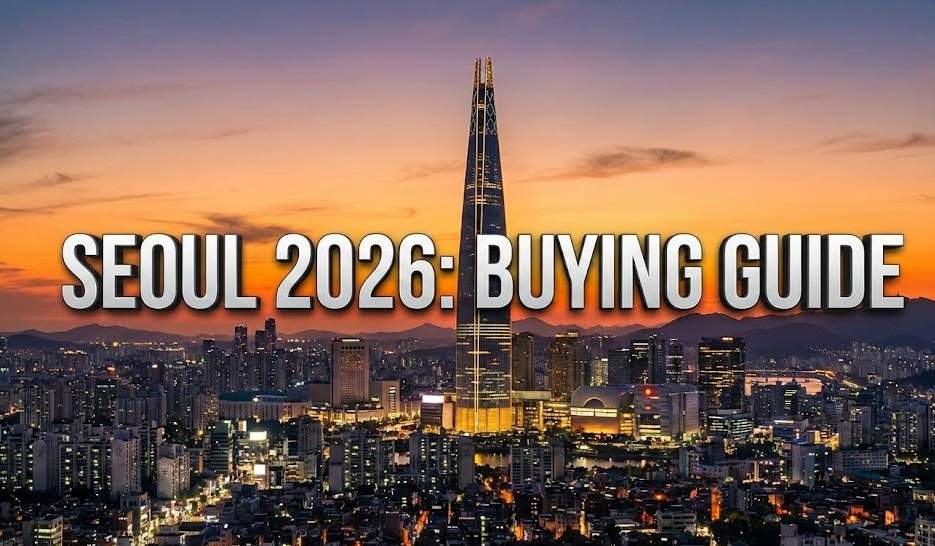
The “Gap Investment” is Dead. Welcome to the “Residency Era.”
Listen, if you’re reading this hoping to buy a $1M condo in Gangnam using a tenant’s deposit (Jeonse) to cover 60% of the cost while you stay in Los Angeles, stop right now. In 2024, that was a smart leverage play. In 2026, that is a fast track to a government fine.
The Seoul real estate market has fundamentally shifted for foreign buyers. The government has expanded “Land Transaction Permit Zones” (토지거래허가구역) to cover the most desirable districts to curb speculation.
Here is the reality: You aren’t just buying a home; you are applying for the privilege to buy it. And the price of admission isn’t just cash—it’s residency.
The “0-Position” Summary: Can US Citizens Buy?
Yes, but with strings attached.
If you are buying in a Permit Zone (Gangnam, Seocho, Songpa, Yongsan), you must obtain permission from the District Office (Gu-office) before the contract is valid.
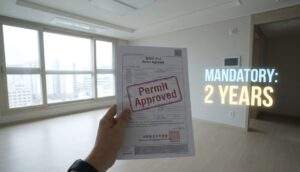
The Kicker: You are legally required to move in within 4 months and reside there for 2 years. Pure investment buying (renting it out immediately) is currently banned in these zones.
The Korea vs. USA Real Estate Showdown
Before we talk wiring millions, let’s anchor this to what you know. Buying in Seoul is not like buying in New York or LA. It is closer to buying a Co-op board apartment in Manhattan (where they interview you), but the “board” is the Korean Government.
Value Comparison: Seoul (Permit Zones) vs. USA (Standard)
| Feature | Seoul (The “Permit” Era) | USA (Standard Market) |
| Speed to Close | Slow (Requires 15-day Gov Approval) | Fast (Offer $\rightarrow$ Escrow $\rightarrow$ Keys) |
| Ownership Type | Freehold (You own the land & unit) | Freehold or Leasehold (Co-ops) |
| Financing (LTV) | Strict (Max 40-50% LTV usually) | Flexible (Up to 95% LTV) |
| Hidden Cost | National Housing Bond (Must buy & sell Gov bonds) | Title Insurance, HOA Transfer Fees |
| The “Catch” | Mandatory 2-Year Residency | High Annual Property Taxes |
| Search Platform | Naver Land / Zigbang (Often outdated) | Zillow / Redfin (MLS is accurate) |
The New Rules: Surviving the “Land Transaction Permit Zones”
This is where 90% of foreigners get stuck. You cannot simply wire money and sign a deed anymore if you are targeting the “Big 4” districts.
1. The Map: Where is Restricted?
If you are looking at premium assets, you are likely looking here:
-
Gangnam-gu (강남구): The Beverly Hills of Seoul.
-
Seocho-gu (서초구): High-end residential, near the Supreme Court.
-
Songpa-gu (송파구): Jamsil, Lotte Tower area.
-
Yongsan-gu (용산구): The “Foreigner District” (Itaewon/Hannam).
Search on Naver Map: Look for ‘토지거래허가구역’ (Land Transaction Permit Zone) to see if your target building is included.
2. The Trap: “Gap Investment” (Jeonse)
In the US, you buy a house and rent it out to cover the mortgage. In Korea, the “Jeonse” (Large lump-sum deposit) system allowed you to buy a house using the tenant’s money as leverage.
The 2026 Rule: In Permit Zones, you cannot take over an existing Jeonse tenant if their lease extends past your 4-month move-in window. You must buy the house “vacant” or with a tenant leaving immediately so you can move in.
3. The Consequence
If you are caught buying under a nominee or faking residency:
-
Fines: Up to 30% of the land price (not the sale price, but still massive).
-
Visa: Immediate cancellation if you are on a resident visa (F-4, F-5, etc.).
The “Money Move”: Financing & The “Audit-Proof” Plan
Funding a purchase here is harder than in the US because of the “Jageum Jodal Gyehoekseo” (자금조달계획서) or Financing Plan.
The “Guilty Until Proven Innocent” Rule
The Korean government treats all foreign funds entering the real estate market as suspicious until verified. You must submit a document detailing exactly where every dollar came from.
-
Self-Financing: You need US Bank Statements + Tax Returns.
-
Borrowed Money: You need a Loan Certificate.
-
Gift: If your parents in the US are helping, you need a Gift Tax Return proof (US or Korea).
Mortgage for Foreigners: The Reality Check
Don’t expect US-style 30-year fixed rates at 3%.
-
Go-To Banks: Shinhan Bank (신한은행), Hana Bank (하나은행), and Woori Bank (우리은행) have dedicated Global Desks.
-
Current Rates (2026 Estimate): 4.2% – 5.5% (Variable is standard).
-
LTV (Loan-to-Value): Usually capped at 40% to 50% for high-priced apartments (over $1.1M USD / 1.5 Billion KRW).
-
Insider Tip: Your 800 Credit Score in the US means nothing here. They look at your Korean income or verified Global income (which must be Apostilled).
Step-by-Step Buying Guide (The “Safe” Path)
Do not click “Buy” on an app. Here is the actual logistics chain.
Step 1: The “Imjang” (임장 – Field Visit)
Apps like Zigbang (직방) and Naver Land (네이버 부동산) are great for browsing, but 50% of the “good” listings are bait. You must visit a local Realtor (Budongsan / 부동산) in the specific neighborhood.
-
Tip: Look for the “Authorized Realtor” sticker on the window.
Step 2: The Permit Application
Once you find the unit, you and the seller apply at the District Office (Gu-office).
-
Timeline: It takes about 15 days for approval.
-
Contract Status: The contract is “pending” until this approval comes through. Do NOT send the down payment (usually 10%) until you have a clause stating: “Contract is void and deposit returned if Permit is denied.”
Step 3: The “Hidden Tax” – National Housing Bonds
This is the weirdest part for Americans. To buy a house, you must buy Korean Government Bonds.
-
The Reality: Nobody keeps them. You buy them and immediately sell them back at a discount (loss).
-
The Cost: This “discount rate” changes daily. Expect to pay roughly $2,000 – $5,000 USD out of pocket as a pure loss during closing. Think of it as an extra “Closing Fee.”
Step 4: The Closing (Balance Payment)
You need to move a lot of cash.
-
Platform Arbitrage: For the down payment or smaller fees, services like Wise are great. But for the massive final balance ($500k+), you need a direct SWIFT wire to your own Korean bank account first, then a domestic transfer to the seller.
-
Warning: Do not wire directly to the Seller’s account from the US. Wire to your Korean account so you have a “Certificate of Foreign Currency Purchase” for tax purposes later.
Logistics & Finance FAQ
Q: Do I need a specific Visa to buy property?
No. A tourist (B-1/B-2) can buy property. However, in a “Permit Zone,” you must reside there for 2 years. If your visa doesn’t allow you to stay for 2 years, you physically cannot fulfill the requirement, meaning your Permit will be denied.
-
Solution: You need an F-4 (Gyopo), F-5 (Permanent Resident), or F-2 (Long-term) visa for Permit Zones.
Q: What is the Acquisition Tax rate?
It works on a sliding scale based on the price and how many homes you own.
-
1st Home (Price > $700k USD): Approx 3.3% – 3.5% (Includes local education tax).
-
2nd Home or more: Can jump to 8% – 12%. (Avoid this!)
Q: Is there a loophole to the “2-Year Live-in” Rule?
Yes. Look for Officetels (오피스텔).
These are mixed-use units (studio/lofts). Many Officetels are exempt from the “Housing” transaction permit rules, meaning you can buy them and rent them out immediately.
-
Search Naver Land for: ‘오피스텔’ (Officetel) instead of ‘아파트’ (Apartment).
Q: How do I calculate the square footage?
Korea uses Pyong (평).
-
Conversion: 1 Pyong $\approx$ 35.5 sq ft (3.3 sq meters).
-
Standard Size: A “34 Pyong” apartment is the standard family size, roughly 1,200 sq ft.
Q: Do I need Title Insurance?
No. It doesn’t exist here. instead, you hire a Judicial Scrivener (Beommusa / 법무사). They handle the title transfer and registration. Their fee is usually around $500 – $1,000 USD. Do not skip this; they are your legal safety net.

Final Verdict: Is It Worth It?
If you are moving back to Seoul to live, yes. The stability of owning your own place in a market where rent (Wolse) is skyrocketing is worth the headache.
But if you are sitting in Chicago looking for a passive income investment? No. The 2026 regulations are specifically designed to stop you. The “Permit Zone” is a fortress.
Your Next Step: Before you even look at a house, check your Visa status. If you don’t have an F-series visa, you likely cannot buy in the districts you actually want. Sort your paperwork, then hit the Budongsan.

Hi, I’m Dokyung, a Seoul-based tech and economy enthusiast. South Korea is at the forefront of global innovation—from cutting-edge semiconductors to next-gen defense technology. My mission is to translate these complex industry shifts into clear, actionable insights and everyday magic for global readers and investors.