
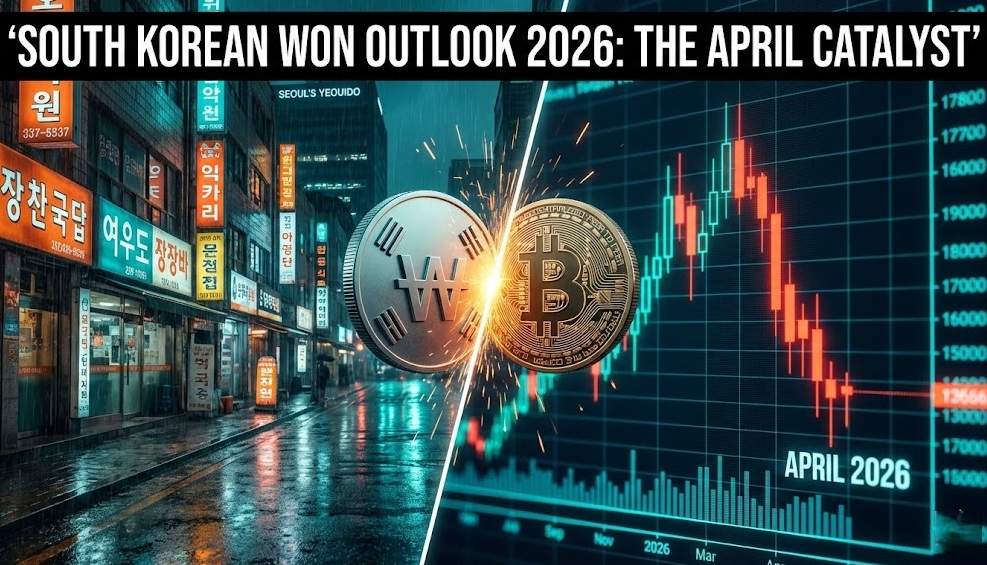
South Korean Won Outlook 2026: Why the ‘April Catalyst’ Changes Everything
If you are reading the standard Wall Street headlines, you’re looking in the wrong direction. Most analysts are obsessed with the US Federal Reserve’s dot plot. But if you want to understand the trajectory of the South Korean Won (KRW) in 2026, you need to look at what is happening in Yeouido (여의도 — Korea’s Wall Street).
We are currently sitting near a historic pain point—or opportunity, depending on your position. The exchange rate has been stubbornly hovering in the 1,450 – 1,470 range against the USD. For Korean locals, this is inflation fuel. For foreign investors, Korean assets are on a “currency discount.”
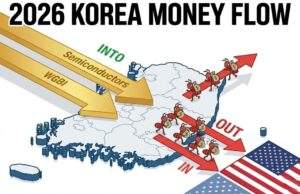
But the charts are flashing a reversal signal. While the Fed’s rate cuts are the headline act, the real mover is the April 2026 WGBI (World Government Bond Index) Inclusion. This is the “Unfair Advantage” insight that most retail traders are missing.
By the end of this guide, you’ll know exactly when to hedge your currency risk, why the “Seohak Ants” are fighting the central bank, and which 3 Korean sectors are poised to pop when the tide turns.
Quick Verdict: Will the Won rise in 2026?
Yes. Analysts project the KRW to appreciate from current levels (~1,450) to 1,375 by Mid-2026. This move will be driven by the narrowing interest rate gap between the US and Korea and the massive capital inflows from the inclusion of Korean bonds in the WGBI starting in April. However, structural outflows from Korean retail investors aggressively buying US Tech stocks will likely limit gains beyond the 1,350 mark.
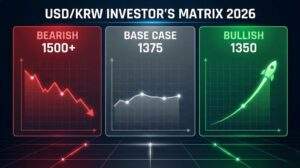
The Investor’s Matrix: 2026 USD/KRW Scenarios
Before we dive into the deep strategy, here is your “Cheat Sheet.” This table outlines the three probable scenarios for 2026, combining macroeconomic data with specific investment actions.
| Scenario | Est. Rate (KRW/USD) | Key Drivers | Investment Action |
|
Bearish Case (Won Weakens) |
1,500+ |
• Fed holds rates high • “Trump Trade” tariffs hit Korean exports • Geopolitical tension |
Long USD, Short KOSPI. Keep cash in USD high-yield accounts. |
|
Base Case (Consensus) |
1,375 – 1,400 |
• Semiconductor Boom (AI Demand) • WGBI Inflows (April 2026) • Fed cuts 2-3 times |
Buy EWY (ETF). Capture the “Double Lift” (Stock gains + Currency gains). |
|
Bullish Case (Won Soars) |
< 1,350 |
• Fed cuts aggressively (50bps+) • Korean exports beat forecasts significantly |
Unhedged Korean Equities. Heavy allocation to Samsung/Hynix. |
The Hidden Drivers: Chips vs. Ants
To trade the Won, you have to understand the tug-of-war happening between Korea’s biggest companies and its own citizens.
1. The Semiconductor Super Cycle (The Bull)
South Korea’s economy is practically synonymous with memory chips. The Bank of Korea (BOK) is targeting 2.0% GDP growth in 2026, and nearly all of that weight rests on the shoulders of Samsung Electronics (삼성전자) and SK Hynix (SK하이닉스).
We are in the middle of an AI-driven “Super Cycle.” Demand for HBM (High Bandwidth Memory) chips used in Nvidia GPUs is skyrocketing.
-
The Logic: When SK Hynix sells billions of dollars of chips to US tech giants, they receive USD. They must convert that USD back to KRW to pay wages and taxes in Korea. This massive corporate selling of Dollars creates natural demand for the Won.
2. The “Retail Exodus” (The Bear)
If exports are so good, why is the Won still stuck at 1,450? Enter the “Seohak Ants” (서학개미).
This is the local slang for Korean retail investors who invest in Western markets. Unlike in the past, Korean investors have lost faith in the domestic KOSPI market. They are aggressively selling their Won to buy US stocks like Nvidia, Tesla, and the S&P 500.
-
The Insider Reality: This creates a “structural outflow.” Even as Samsung brings dollars in, the “Ants” are sending dollars out. This creates a floor for the exchange rate, making it very difficult for the Won to strengthen past 1,350, regardless of how well the economy does.
The April 2026 Catalyst: WGBI Inclusion
This is the specific event you need to mark on your calendar.
FTSE Russell announced that South Korean government bonds will be added to the World Government Bond Index (WGBI) starting April 2026.
-
What this means: Passive funds that track this index are mandated to buy Korean bonds.
-
The Number: Estimates suggest this will trigger an inflow of $50 billion to $60 billion USD into the Korean market over 12-18 months.
-
The Trade: These funds have to sell USD to buy KRW to purchase the bonds. This creates sustained, structural buying pressure on the Won starting in Q2 2026.
Strategic Portfolio Moves (How to Monetize)
You aren’t here just for a forecast; you’re here to make money. Here is how to position yourself based on the 2026 outlook.
1. For Stock Investors: The “Double Lift” on EWY
The iShares MSCI South Korea ETF (EWY) is your primary vehicle.
If the Base Case plays out (Won moves from 1,450 to 1,375), US-based investors get a free kicker.
-
The Math: If Korean stock prices stay flat, but the Won strengthens by 5%, your EWY holding (priced in dollars) goes up by roughly 5%.
-
The Strategy: Accumulate Korean equities in Q1 2026. You want to be positioned before the WGBI inflows begin in April.
2. For Forex Traders: Play the Range
Until April 2026, the Won will likely remain volatile.
-
Resistance: 1,470. If it hits this, the Bank of Korea often verbally intervenes or sells reserves. This is a “Sell USD” zone.
-
Support: 1,400. Structural outflows from the “Ants” make it hard to break below this. This is a “Buy USD” zone.
3. For Expats & Travelers: Remittance Timing
If you need to move money into Korea (e.g., for “Jeonse” deposit or living expenses):
-
Action: Do it NOW. With rates hovering around 1,450+, you are getting historically great value for your Dollars or Euros.
-
Warning: Do not wait until late 2026. If the rate drops to 1,375, you effectively lose ~5% of your purchasing power.
-
Platform Tip: Don’t use traditional banks. Use platforms like Wise or Revolut to lock in the spot rate.
Insider FAQ: The Questions You Should Be Asking
Q1: Will the South Korean Won crash in 2026?
A: Highly unlikely. Unlike the 1997 crisis, South Korea now holds over $400 billion in foreign exchange reserves (top 10 in the world). While 1,500 KRW/USD is a psychological “danger zone,” the BOK has enough firepower to prevent a total collapse.
Q2: What is the best time to exchange USD for KRW in 2026?
A: Q1 2026 (Jan-March). You want to exchange your foreign currency before the WGBI inclusion kicks in effectively in April, which is expected to start driving the Won’s value up (and the exchange rate down).
Q3: How do US Tariffs affect the Won?
A: They hurt it. South Korea is an export-led economy. If the US imposes universal tariffs (a “Trump Trade” scenario), Korean exports become more expensive, reducing the amount of dollars entering the country. This pushes the Won weaker (towards 1,500).
Q4: Why is the interest rate gap so important?
A: Currently, US rates are much higher than Korea’s 2.50% (approx). Money flows to where it earns the highest yield. As the US Fed cuts rates in 2026, that gap narrows, making the USD less attractive compared to the KRW, helping the Won strengthen.
Q5: Is crypto a factor in the exchange rate?
A: Surprisingly, yes. The “Kimchi Premium” (Bitcoin trading higher in Korea) drives capital outflows as arbitrage traders try to move money. However, strictly regulated capital controls limit this impact compared to the massive flows from the Semiconductor and Bond markets.
Conclusion: The Window is Closing
The “cheap Won” era is nearing a pivot point. The confluence of the semiconductor super cycle and the massive April 2026 WGBI liquidity injection suggests that the days of the 1,450 exchange rate are numbered.
Whether you are a forex trader looking to short the top, or an equity investor looking for undervalued assets, Q1 2026 is your accumulation zone. Don’t wait until the news headlines in April tell you what the insiders in Yeouido already know.

Hi, I’m Dokyung, a Seoul-based tech and economy enthusiast. South Korea is at the forefront of global innovation—from cutting-edge semiconductors to next-gen defense technology. My mission is to translate these complex industry shifts into clear, actionable insights and everyday magic for global readers and investors.