
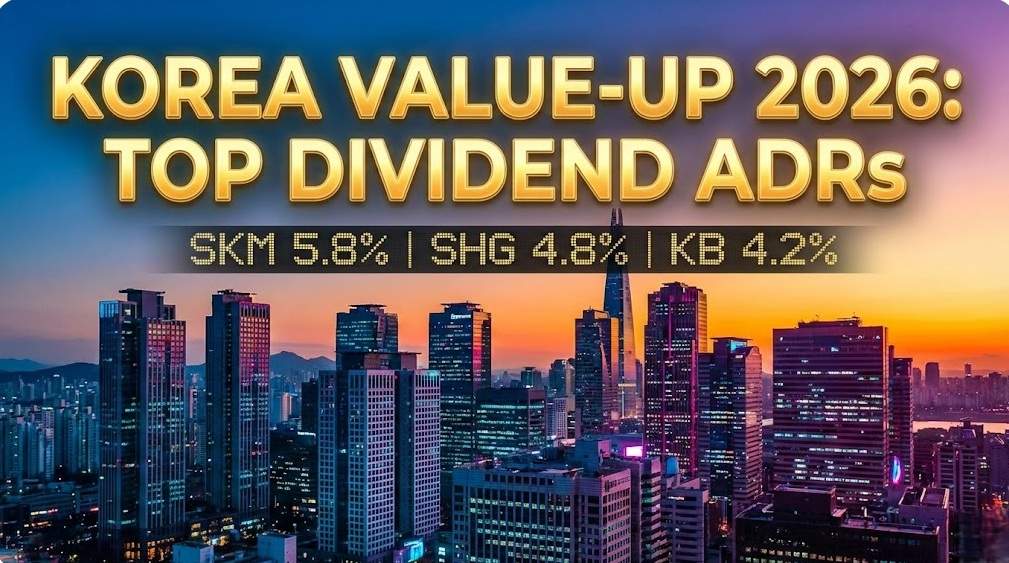
Top Korean Dividend Stocks & ADRs: The 2026 “Value-Up” Cheat Sheet
Listen to me carefully. Most foreign investors look at the South Korean stock market and get scared. They see news about the North, they see complex family-run conglomerates (Chaebols), and they run back to the S&P 500.
That is exactly why you need to be here.
Welcome to the land of the “Korea Discount” (코리아 디스카운트). For decades, Korean companies have traded at dirt-cheap valuations compared to their global peers. Why? Because they hoard cash and don’t pay enough dividends.
But the game has changed.
The South Korean government has launched the “Corporate Value-Up Program” (기업 밸류업 프로그램). They are literally twisting the arms of major corporations to boost stock prices and—you guessed it—increase dividends.
I’m your local insider (“Hyung”). I’m not going to tell you to gamble on risky biotech stocks on the KOSPI. I’m going to show you how to buy safe, massive, cash-printing Korean giants that are listed right on the New York Stock Exchange (NYSE). You don’t need a Korean bank account. You don’t need to speak Hangul. You just need to know which tickers to buy before the rest of Wall Street wakes up.
The “Hyung” Promise: No penny stocks. No complex foreign trading accounts. Just high-yield American Depositary Receipts (ADRs) that pay you to wait for the capital appreciation boom.
🚀 Quick Answer: The Top 3 Korean ADRs for Income
If you’re in a rush and just want the tickers, here is the “Holy Trinity” of Korean income:
-
SK Telecom (SKM): The “Verizon of Korea.” Stable, massive monopoly. ~5.8% Yield.
-
Shinhan Financial (SHG): Top-tier banking giant. ~4.8% Yield.
-
KB Financial (KB): The “JPMorgan of Korea.” Deep value play. ~4.2% Yield.
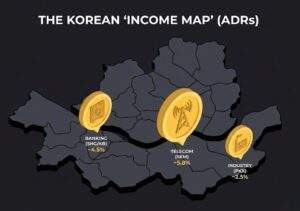
The “Korean Cheat Sheet”: Top High-Yield ADRs
Don’t search blindly. Here is your cheat sheet. These are American Depositary Receipts (ADRs), meaning you can buy them on Fidelity, Robinhood, or Schwab just like you buy Apple or Tesla.
| Ticker | Company Name (Hangul) | Approx. Yield | Sector | The “Hyung” Verdict |
| SKM | SK텔레콤 (SK Telecom) | ~5.8% | Telecom | Defensive Income. The safest bet. |
| SHG | 신한지주 (Shinhan Fin.) | ~4.8% | Banking | Growth + Income. Best management. |
| KB | KB금융 (KB Financial) | ~4.2% | Banking | Value Play. Insanely cheap assets. |
| KT | KT (KT Corp) | ~4.9% | Telecom | High Yield. High reliable cash flow. |
| PKX | POSCO홀딩스 (POSCO) | ~2.5% | Steel/Materials | Cyclical Growth. For the battery metal play. |
Pro Tip: While these trade in US Dollars, the underlying assets are in Korean Won (KRW). If the Won gets stronger against the Dollar, your returns go up. It’s a currency hedge.
In-Depth Analysis: The “Big Three” Income Generators
Let’s get off the tourist path and look at the fundamentals. Why are we buying these specific companies?
1. SK Telecom (SKM) – The “Bond Proxy”
Hangul: SK텔레콤
Sector: Telecommunications
If you walk down any street in Seoul, from the neon lights of Gangnam (강남) to the indie vibes of Seongsu-dong (성수동), everyone is glued to their phones. SK Telecom controls nearly 50% of the mobile market here. They are the monopoly.
-
The Bull Case: This is a utility stock disguised as a tech stock. They generate massive cash flow because Koreans simply do not cancel their phone plans. They are now expanding aggressively into AI data centers and the metaverse (Ifland).
-
The Bear Case: Growth is slow. Everyone in Korea already has a phone. It’s a mature market.
-
Dividend Safety Score: 5/5. This is as safe as it gets in Korea.
Sensory Vibe: Imagine standing in a packed subway car on Line 2 during rush hour. Silence. Just the soft tapping of thumbs on screens. That silence is the sound of SK Telecom making money.
👉 Action: Add $SKM to your watchlist for defensive income.
Shinhan Financial Group (SHG) – The “Cash Cow”
Hangul: 신한지주
Sector: Banking & Finance
Walk into the financial district of Yeouido (여의도)—the “Manhattan of Seoul”—and you will see the blue Shinhan logo everywhere. Korean banks are notoriously undervalued, trading at Price-to-Book (P/B) ratios of 0.3 to 0.5. That means you are buying $1.00 of assets for 40 cents.
-
The Bull Case: The Corporate Value-Up Program targets banks specifically. The government is basically saying, “Stop hoarding cash, pay the shareholders.” Shinhan has committed to cancelling shares (buybacks) and increasing dividends.
-
The Bear Case: Real estate exposure. If the Korean housing market crashes, banks take a hit.
-
Dividend Safety Score: 4/5. Very strong, but sensitive to interest rate cuts.
👉 Action: Check the P/E Ratio of $SHG. If it’s under 5.0, it’s a buy.
KB Financial Group (KB) – The Value King
Hangul: KB금융
Sector: Banking & Finance
KB is the fiercest rival to Shinhan. They own Kookmin Bank, which is arguably the most popular retail bank for everyday Koreans.
-
The Bull Case: KB has consistently delivered higher Returns on Equity (ROE) than its peers. They are aggressive with shareholder returns. Under the new government guidelines, KB is leading the pack in promising to double their dividend payout ratio over the next few years.
-
The Bear Case: Similar to Shinhan, regulatory risk is a factor. The government sometimes pressures banks to lower interest rates to help the public (“Public Interest” vs. “Shareholder Interest”).
-
Dividend Safety Score: 4/5.
Insider Insight: Search for “KB Star Banking” on the App Store. The sheer dominance of their Super App ecosystem in Korea is something US banks dream of.
👉 Action: Compare $KB vs $SHG and buy the one with the lower P/B ratio.
The “Hidden” Cost: Understanding the 15.4% Tax
Okay, here is the part where most travel blogs… excuse me, financial blogs… fail you. They don’t tell you about the tax.
When a Korean company pays you a dividend, the Korean government takes a cut before it ever leaves the country.
-
The Withholding Tax: South Korea generally withholds 15.4% (Income Tax + Local Tax) on dividends paid to foreign investors.
-
What this means: If SKM declares a $1.00 dividend, you will likely see $0.846 hit your brokerage account.
The “Hyung” Hack: The Foreign Tax Credit (FTC)
Disclaimer: I am an insider, not a CPA. Talk to your tax pro.
However, the US and Korea have a tax treaty. You typically do not get double-taxed. When you file your US taxes (Form 1040), you can usually claim the Foreign Tax Credit (Form 1116). This lets you deduct the tax you paid to Korea from the tax you owe to the IRS.
Bottom line: Don’t let the 15.4% scare you. The net yield is still often higher than US equivalents.

Why Now? The “Corporate Value-Up” Catalyst
Why buy in 2026? Because the “Korea Discount” is ending.
In the past, Korean Chaebols (family conglomerates) didn’t care about stock prices because the families controlled the companies regardless of the share price. But the Financial Services Commission (FSC) of Korea has launched the Corporate Value-Up Program.
The New Rules:
-
Companies must disclose plans to improve valuation (P/B ratios).
-
A new “Korea Value-Up Index” has been launched (ETFs will track this, forcing capital into these stocks).
-
Tax incentives are being offered to companies that increase shareholder returns.
You are entering the market during a structural reform. This is like buying Japanese stocks in 2023 just before their historic run-up.

Insider FAQ: Questions You Were Afraid to Ask
1. How do I actually buy these? Do I need a special account?
No. The stocks listed above are ADRs (American Depositary Receipts). They trade on the NYSE. You buy them exactly like you buy Coke or Disney. No special permissions needed.
2. Is Samsung Electronics (Samsung) a good dividend stock?
Search for ‘삼성전자’ on Naver Finance. It is a great company, but it is a growth stock, not a high-yield stock. The yield hovers around 2% or less. If you want income, buy the Banks (Shinhan/KB) or Telecoms (SKM). Buy Samsung for capital gains, not for the dividend check.
3. How often do they pay?
Historically, Korean companies paid once a year (year-end). This is changing. Most major companies like SKM, KB, and SHG have moved to Quarterly Dividends to attract foreign investors. You get paid four times a year, just like in the US.
4. What is the biggest risk?
Currency. You are buying an asset priced in Won (KRW).
-
If KRW goes up vs USD: You win (Dividend is worth more dollars).
-
If KRW crashes vs USD: You lose (Dividend buys fewer dollars).
-
My take: The Won is historically undervalued right now. The risk/reward favors the upside.
5. Why are the yields so high? Is it a trap?
It’s not a trap; it’s a cultural legacy. Korean stocks are cheap because of poor corporate governance in the past. The high yield is the market’s way of compensating you for that risk. As governance improves (Value-Up Program), the share prices will rise, and yields will normalize. You are capturing the “inefficiency premium.”
Conclusion: Don’t Just Visit Korea—Own a Piece of It
You come to Korea for the BBQ, the skincare, and the culture. But the smartest travelers leave with a portfolio that pays for their next trip.
The “Korea Discount” won’t last forever. The government is pushing hard, the Chaebols are listening, and the dividends are flowing. By sticking to the massive, blue-chip ADRs like SK Telecom and Shinhan Financial, you are taking a safe, calculated bet on the growth of Asia’s 4th largest economy.
Search for the tickers. Check the charts. And when that dividend hits your account, go treat yourself to some real Korean BBQ. You earned it.

Hi, I’m Dokyung, a Seoul-based tech and economy enthusiast. South Korea is at the forefront of global innovation—from cutting-edge semiconductors to next-gen defense technology. My mission is to translate these complex industry shifts into clear, actionable insights and everyday magic for global readers and investors.