

Why Korean Stocks Are Cheap: 3 Hidden Reasons (It’s Not North Korea)
Listen, I know why you’re here. You look at companies like Samsung or Hyundai, you see their massive global dominance, and then you look at their stock price and think, “Wait, why is this so cheap compared to Apple or Tesla? Is this the sale of the century?”
Welcome to the Korea Discount (코리아 디스카운트).
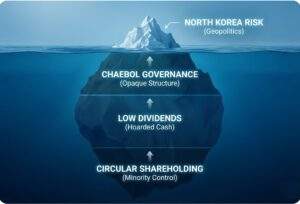
Most foreign investors—and honestly, most “gurus” on Wall Street—think Korean stocks are cheap because of the scary guy up North (Kim Jong Un). That is a myth. If you think you can just buy the biggest ETF and wait for peace on the peninsula to get rich, you are falling into a financial tourist trap.
I’m here to tell you the real story. The “discount” isn’t about war; it’s about governance, family empires (Chaebols), and how they treat shareholders like you. But things are changing with the new “Corporate Value-Up Program” (기업 밸류업 프로그램).
Here is the street-smart guide to navigating the Korean market without getting played.
The “US Investor Cheat Sheet” for Korean Stocks
Before we dive deep, here is your quick-reference guide. Stop using Google Finance; the real data is on Naver Finance (네이버 금융).
| Investment Vehicle | Ticker / Search Name | Expense Ratio | The “Insider” Verdict | Naver Search (Hangul) |
| The “Tourist” ETF | EWY (iShares) | 0.59% | Avoid. Too expensive. Only for day traders needing liquidity. | iShares MSCI South Korea |
| The “Smart Money” ETF | FLKR (Franklin) | 0.09% | Buy. Same exposure, drastically lower fees. The local’s choice for long-term hold. | Franklin FTSE South Korea |
| The “King” Stock | Samsung Electronics | N/A (OTC: SSNLF) | Caution. Buying OTC in the US is messy. Buy via ETF or a broker with Int’l access. | 삼성전자 |
| The Value Play | KB Financial | KB (ADR) | Strong Buy. Banks are actually following the new government rules to boost prices. | KB금융 |
Pro Tip: If you are holding a Korean position for more than a year, switch from EWY to FLKR immediately. You are paying over 6x the fees for essentially the same basket of stocks. Wall Street loves charging you that “laziness tax.” Don’t pay it.
The Real Reason Korea is “On Sale” (It’s Not North Korea)
When you hear “Korea Discount,” you need to understand three specific Korean terms. This is what actually moves the market here in Seoul.
1. The Chaebol (재벌) Structure
In the US, the Board of Directors works for you, the shareholder. In Korea, for decades, the Board worked for the Chaebol (family-run conglomerates like Samsung, SK, LG).
Even if the family owns only 5% of the company, they control 100% of the decisions through a complex web called “circular shareholding.”
-
The Result: They hoard cash rather than paying dividends. Korea’s dividend payout ratio hovers around 20-22%, while the global average is closer to 40%.
2. The Lack of Fiduciary Duty (Until Now)
This is the technical part that makes US investors scream. Under previous Korean Commercial Law, directors had a duty to the company, but not to the shareholders.
-
The Scam: A company could spin off its best division (like LG Chem spinning off LG Energy Solution), crashing the stock price for existing holders, and it was perfectly legal.
3. The “Value-Up” Program (기업 밸류업 프로그램)
This is why you are reading this guide right now. The Korean government looked at Japan, saw how Tokyo fixed their stock market in 2023, and said, “We need to do that.”
They are now shaming companies with low P/B (Price-to-Book) ratios and forcing them to disclose plans to boost shareholder returns.
Local Insight: You can check which companies are compliant by searching for the “Korea Value-Up Index” (코리아 밸류업 지수) on Naver.
How to actually Buy (Without Getting Ripped Off)
You have three lanes here. Choose the one that fits your risk tolerance.
The “Safe & Cheap” Lane: FLKR
As mentioned in the cheat sheet, FLKR is the heavy hitter for value. It tracks the FTSE South Korea Capped Index.
-
Why: It gives you broad exposure (Samsung, SK Hynix, Hyundai) without the massive expense ratio of EWY.
-
Vibe: This is like buying your groceries at E-Mart (local, fair price) instead of the Department Store basement (overpriced for the same apple).
The “Sniper” Lane: Financials & Autos
If you want to play the “Value-Up” reforms specifically, look at Banks (KB, Shinhan) and Autos (Hyundai, Kia).
-
Why: These sectors have historically had the lowest valuations (trading below book value). The government is pressuring them the hardest to buy back shares and increase dividends.
-
Naver Search: Look for KB금융 (KB Financial) or 현대차 (Hyundai Motor).
The “Hard Mode” Lane: Direct Investing (KOSPI)
If you are serious, open an account with a broker that allows direct access to the KOSPI (코스피) exchange, like Interactive Brokers.
-
Warning: You will need to convert USD to KRW (Won). Watch the exchange rate. The Won has been volatile against the Dollar.
Insider FAQ: The Stuff Nobody Tells You
1. Can I just buy Samsung stock (Samsung Electronics) directly in my US brokerage app?
Technically, you might see a ticker like SSNLF or SSNNF. Don’t touch them. These are “Grey Market” OTC tickers with terrible liquidity and huge spreads. If you want Samsung, buy an ETF that holds it (FLKR/EWY) or open an international brokerage account to buy the real 삼성전자 on the KOSPI.
2. Is the “North Korea Risk” completely fake?
It’s not fake, but it’s priced in. We locals call it the “coexistence risk.” The market doesn’t crash every time a missile flies; it crashes when US interest rates move. The Chaebol governance issue is 90% of the discount; North Korea is maybe 10%.
3. What about taxes?
Korea has a transaction tax on selling stocks (though it’s being lowered), and dividends are subject to a withholding tax (usually 15.4% locally, but varies by treaty for US investors). If you buy an ETF like FLKR, the fund handles the foreign withholding logistics, but you still pay taxes on distributions. Always talk to a CPA, I’m just a Hyung with a blog.
4. Why is everyone talking about the “Commercial Act Amendment”?
This is the big catalyst. The amendment aims to legally force directors to protect shareholder interests, not just the company entity. If this fully passes and is enforced, the “Korea Discount” could vanish, and valuations could jump 20-30% to match global peers.
5. Which Korean app should I use to track these stocks?
Delete Yahoo Finance. Download the Naver app or use Naver Finance (finance.naver.com). Use Google Translate on the page. It gives you the real-time news, the “Discussion” boards (where retail investors rant—very entertaining), and accurate foreign ownership data.
Conclusion: The “Hyung” Verdict
Korea is not a market for “set it and forget it” passive income—yet. It is a market for active traders and value hunters. The “Korea Discount” is real, but the gap is closing thanks to the Value-Up reforms.
If you believe the Korean government will succeed in pressuring the Chaebols to share their wealth, then buying FLKR or KB Financial right now is a smart asymmetric bet. Just remember: In Korea, patience isn’t just a virtue; it’s the only way to survive the volatility.
Next Step: Go to your brokerage account right now and check the expense ratio of your Korea holdings. If it’s above 0.50%, you know what to do.

Hi, I’m Dokyung, a Seoul-based tech and economy enthusiast. South Korea is at the forefront of global innovation—from cutting-edge semiconductors to next-gen defense technology. My mission is to translate these complex industry shifts into clear, actionable insights and everyday magic for global readers and investors.