

Sundae-guk Guide: The $7 Hangover Miracle You Need
Let’s get the elephant in the room out of the way immediately: No, this has nothing to do with ice cream.
If you order a “Sundae” in Seoul expecting vanilla scoops and hot fudge, you are going to be very confused when you receive a steaming earthenware bowl filled with savory broth and sausage.
As your “Korea Insider,” I know the word “Blood Sausage” triggers a specific fear in most Americans. You’re thinking of a metallic, iron-heavy taste or something straight out of a horror movie. Stop right there.
Think of Korean Sundae (순대) not as a “blood sausage,” but as a “Savory Glass Noodle Sausage.” It is closer to a chewy Cajun Boudin than it is to a chunk of liver. It is rich, mild, and arguably the best hangover cure on the planet.
More importantly, it is a massive money-saver. While a trendy K-Town restaurant in NYC or LA will charge you $22+ USD for a bowl, I’m going to show you how to get the exact same quality at home for $7 USD using the right retort pouches.
Here is your wallet-friendly guide to mastering the “Soul Food of Seoul.”
The Korea vs. US Cheat Sheet: The Price of “Authentic”
Use this table to decide if you should fly to Seoul, drive to K-Town, or just hit “Add to Cart.”
| Category/Item | Price in Korea | US Price Equivalent | Where to Buy (Best Value) | Naver Map / Search Name |
| Restaurant Sundae-guk | $7.50 USD (10,000 KRW) | $18 – $24 USD (NYC/LA) | Local K-Town Restaurant | 순대국 (Sundae-guk) |
| Instant Retort Pouch | $3.50 USD (4,500 KRW) | $6 – $9 USD | [H-Mart / Weee! / Amazon] | 비비고 순대국 (Bibigo) |
| Ddukbaegi (Stone Bowl) | $4.00 USD (5,000 KRW) | $25 – $35 USD | [Amazon US (Essential Gear)] | 뚝배기 (Ddukbaegi) |
| Soju (The Pairing) | $1.50 USD (2,000 KRW) | $6 – $14 USD | Local Liquor Store | 참이슬 (Chamisul) |
Insider Value Tip: The price gap on the soup itself is massive. In the US, you are paying a 300% markup for the atmosphere. If you are budget-conscious, the “Retort Pouch” route (explained below) is the smartest financial move you can make.
Sundae-guk Taste Profile: Comparing Korean Sundae vs. Cajun Boudin vs. Black Pudding
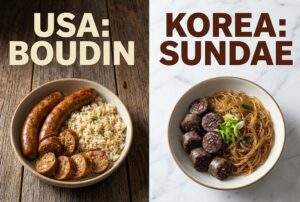
Keyword Focus: Korean Blood Sausage Taste, Texture Comparison
If you are hesitant to try this because of the word “blood,” you need to understand the “Sausage Spectrum.”
Most Westerners assume Sundae is like British Black Pudding, which is often oat-based, dry, crumbly, and has a distinct metallic iron taste. Korean Sundae is completely different.
The “Sausage Spectrum” Breakdown
-
The Filler: The main ingredient in Korean Sundae is Dangmyeon (Sweet Potato Glass Noodles).
-
The Texture: Because of the noodles, the texture is bouncy, chewy, and mochi-like. It is not mushy or crumbly.
-
The Flavor: It is savory, earthy, and mild. The blood acts more as a binder and a coloring agent than a primary flavor profile.
Think of it like this:
-
Cajun Boudin: Rice + Meat (Soft texture).
-
British Black Pudding: Oats + Blood (Crumbly/Dry texture).
-
Korean Sundae: Glass Noodles + Vegetables + Blood (Chewy/Bouncy texture).
If you like boba pearls or mochi, you will likely enjoy the texture of Sundae.
Shopping Guide: Best H-Mart Instant Sundae-guk Brands (Save $15 Per Bowl)
Keyword Focus: Best Instant Sundae-guk, H-Mart Retort Pouch Reviews
You could try to make this from scratch, but cleaning pork intestines and boiling bones for 12 hours is a nightmare for a home cook. Even Koreans buy this pre-made.
The secret to “high-value” dining is the Retort Pouch (Instant Pack). These are fully cooked, shelf-stable (or frozen) soups that you just boil and eat.
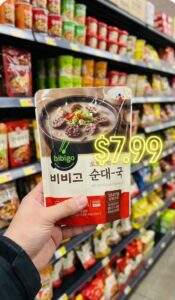
1. The “Beginner Friendly” Choice: Bibigo (비비고)
-
Price: ~$7.99 USD
-
Flavor: Very clean, mild pork broth. Almost no “funk.”
-
Pros: widely available at H-Mart, Weee!, and sometimes Costco.
-
Cons: The sausage pieces can be small.
-
Verdict: Buy this first. If you like Ramen, you will like this.
2. The “Authentic” Choice: Peacock / H-Mart House Brands
-
Price: ~$8.99 USD
-
Flavor: Richer, deeper pork scent. The broth is creamier (like a Japanese Tonkotsu).
-
Pros: Generous meat portions (often includes ear or lung cuts, which are traditional).
-
Cons: Harder to find outside of major cities.
-
Verdict: For the foodie who wants the real “Market Style” taste without the plane ticket.
The “Wallet” Calculation:
If you buy a pouch for $8 and a pack of microwave rice for $2, your total cost is $10. Compared to a $25 restaurant bill (after tax and tip), you are saving $15 per meal.
The Essential Gear: Why You Need a Ddukbaegi (Earthenware Bowl)
Keyword Focus: Korean Earthenware Bowl, Ddukbaegi Amazon
You cannot eat Sundae-guk in a regular cereal bowl. It defies the laws of Korean physics.
You need a Ddukbaegi (뚝배기). This is the dark brown/black earthenware bowl you see in every K-Drama.
The “Science” of the Spend:
-
Thermal Mass: Sundae-guk is a fatty pork broth. If it cools down, the fat solidifies and creates a film on your lips. The Ddukbaegi retains heat so aggressively that the soup stays boiling while you eat it, keeping the fat emulsified and delicious.
-
Value: A good size 3 (approx. 4-5 inch diameter) bowl costs about $25 USD on Amazon. It lasts forever.
-
Versatility: You can use it for Soft Tofu Stew (Soondubu), Miso Soup, and even steaming eggs.
Pro Tip: When you buy a Ddukbaegi, do not wash it with soap! The clay is porous and will absorb the soap flavor. Wash it with hot water and baking soda.
Health & Nutrition: The “Superfood” For Hangovers & Skincare
Keyword Focus: Hangover Cure Food, Collagen Benefits, Iron Rich Soup
In the US, we drink Gatorade or take Advil for a hangover. In Korea, we eat Haejang-guk (Hangover Soup), and Sundae-guk is the king of this category.
Is it worth the money for the health benefits? Absolutely.
-
The Hangover Cure: The rich pork broth is full of electrolytes and fat, which settles the stomach. The steam clears your sinuses.
-
The “Beauty” Soup (Collagen): The broth is made by boiling pork bones for hours. It is loaded with natural collagen, which is expensive if you buy it as a supplement powder at Sephora. Here, you just drink it.
-
Iron Boost: The Sundae itself (containing blood) is a potent source of heme iron, essential for energy and combating anemia.
The Comparison:
-
Multivitamin Pack: $1.50 per serving.
-
Collagen Powder: $2.00 per serving.
-
Sundae-guk: Gives you both, plus a meal, for $7.00.

FAQ: Logistics & Safety for the First-Timer
Keyword Focus: Eating Blood Sausage Safety, Sundae-guk Spice Level
1. Is it safe to eat “Blood” sausage?
Yes. In both the US (pouches) and Korea, the blood is fully cooked (steamed or boiled) during the manufacturing process. It is not raw. It is as safe as eating a hot dog.
2. Is Sundae-guk spicy?
By default, no. The broth is milky white and savory. However, it is usually served with a side of Dadaegi (다대기), a red chili paste. You control the spice level. If you want it red and fiery, add a spoonful. If you want it mild, leave it out.
3. Do I eat the casing?
Yes. The casing is usually edible intestine (like a natural sausage casing) or a cellulose skin. Eat the whole thing.
4. Can I find this on Amazon?
You can find the Retort Pouches (brands like Bibigo) on Amazon, though they are often cheaper at Weee! or H-Mart online due to shipping costs for liquids. You can definitely find the Ddukbaegi (bowls) on Amazon.
5. How do I ask for it without the “weird” organs?
If you are at a restaurant and only want the sausage (no ear, liver, or stomach slices), tell the server:
-
“Sundae-man juseyo” (Sausage only, please).
-
Hangul: 순대만 주세요.
Conclusion: Don’t Let Fear Cost You Flavor
Sundae-guk is the ultimate example of “don’t judge a book by its cover.” It is cheaper than a steak, healthier than a burger, and offers a depth of flavor that a standard chicken noodle soup can only dream of.
Next time you are at H-Mart, walk past the Ramen aisle and grab a pouch of Sundae-guk. Get your stone bowl heating up on the stove. You aren’t just saving money on a flight to Seoul; you’re unlocking a level of Korean cuisine that most tourists never get to experience.

Hi, I’m Dokyung, a Seoul-based tech and economy enthusiast. South Korea is at the forefront of global innovation—from cutting-edge semiconductors to next-gen defense technology. My mission is to translate these complex industry shifts into clear, actionable insights and everyday magic for global readers and investors.