

Dwaeji Gukbap vs. Tonkotsu Ramen: The “No-Bloat” Broth That Saves You $10
You know that feeling after smashing a bowl of rich Tonkotsu Ramen? You feel happy for 20 minutes, then the sodium spike and carb-coma hit you like a freight train. You want a nap, not a night out.
Here is the insider secret: Dwaeji Gukbap (돼지국밥) is the “cleaner,” smarter cousin of the Japanese Tonkotsu. It uses a similar creamy pork bone broth technique, but it strips away the heavy wheat noodles and massive sodium load in favor of steamed rice and a customizable seasoning ritual.
Think of it as the “Keto-Friendly Bone Broth” of the Korean culinary world.
For my friends in the US, you are usually paying $18+ USD for a bowl of subpar ramen. I’m going to show you how to get a healthier, authentic Korean meal for a fraction of the price—whether you are microwave-hacking it from Amazon or booking a KTX train to Busan.
💰 The “Korea vs. US” Value Comparison Table
Before we dive into the broth, let’s look at the numbers. Is it worth buying the retort pouch, or should you fly to Korea?
| Category / Item | Price in US (USD) | Price in Korea (USD/KRW) | Where to Buy / Search |
| Restaurant Bowl | $16 – $22 USD (NYC/LA) | $6.50 – $7.50 USD (9,000 KRW) | Naver Map: 돼지국밥 |
| Retort Pouch (Instant) | $5 – $7 USD (Amazon/H-Mart) | $3 – $4 USD (4,500 KRW) | Amazon US: Bibigo Soup |
| Travel Cost (KTX Ticket) | N/A | $45 USD (59,800 KRW) | Seoul to Busan (One Way) |
| Gluten Content | High (Wheat Noodles) | Zero (If eaten without red paste) | N/A |
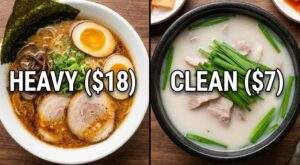
Dwaeji Gukbap vs. Tonkotsu: The Nutritional Showdown
What is the difference between Dwaeji Gukbap and Tonkotsu Ramen?
Dwaeji Gukbap is a Korean pork bone soup served with rice, whereas Tonkotsu is a Japanese noodle dish. The critical difference is the seasoning: Dwaeji Gukbap is served completely unseasoned (bland), requiring the diner to add salted shrimp (Saeujeot) and chives at the table. This makes it significantly lower in sodium by default and generally gluten-free, whereas Tonkotsu broth is pre-seasoned with soy sauce or miso (tare) and full of wheat carbs.
If you are tracking your macros or trying to avoid the “bloat,” Gukbap wins every time.
1. The “Clean Keto” Advantage
Japanese Ramen relies on alkaline wheat noodles. A standard serving can easily exceed 800 calories and 70g of carbs.
Dwaeji Gukbap focuses on the protein and collagen. The broth is boiled for 24+ hours until the bones dissolve into a milky white soup.
-
Pro Tip: If you are strictly Keto, order it without rice (bap-ppaego / 밥 빼고). You’ll get a bowl of pure, rich bone broth and pork slices.
2. The Sodium Control
In a ramen shop, the chef decides how salty your soup is. In a Gukbap joint, you are the chef. The soup comes out boiling hot and completely bland. You control the sodium level using Saeujeot (Salted Shrimp). This is crucial for anyone watching their blood pressure or water retention.
How to Eat Like a Local: Mastering the ‘Saeujeot’ Ritual
Do not sip the soup immediately and complain that “it tastes like hot water.” That is a rookie mistake. You must build the flavor profile. Here is the standard operating procedure (SOP) for eating Dwaeji Gukbap:
Step 1: The Digestive Aid (Saeujeot / 새우젓)
These tiny fermented shrimp are not just salt substitutes; they contain enzymes (protease and lipase) that help your body break down pork fat.
-
Action: Add one teaspoon of the shrimp (liquid and solids) into the soup.
Step 2: The “Green” Dump (Buchu / 부추)
You will be served a side of garlic chives (Buchu). These are not a side salad.
-
Action: Dump the entire plate of chives into the soup while it is still boiling (over 200°F / 95°C) to wilt them slightly.
Step 3: The Heat (Dadaegi / 다대기)
This is a red pepper paste.
-
Action: If you want it spicy, add a dollop. If you want a “clean” white broth, skip this.
Buying Guide: Amazon vs. H-Mart Retort Pouches
Let’s be real—you aren’t going to boil pork bones for 24 hours in your apartment. It smells, and it’s expensive. The “Insider” move is to buy Retort Pouches.
These are shelf-stable soups that taste 90% as good as the restaurant version for 30% of the price.
Top Picks for US Residents:
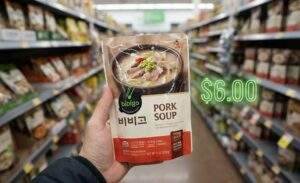
1. Bibigo Pork Bone Soup (비비고)
-
The Verdict: The “Starbucks” of Korean instant food. Reliable, consistent, and easy to find.
-
Cost: Approx $6 USD per pack on Amazon or local H-Mart.
-
Where to Buy: Check the “Asian Foods” aisle or [Search “Bibigo Pork Soup” on Amazon].
2. Peacock (Emart Brand)
-
The Verdict: Higher quality meat cuts, often found in larger Korean marts (H-Mart, Zion Market).
-
Cost: Approx $7 – $8 USD.
3. The DIY Upgrade Hack
Don’t just microwave the pouch.
-
Pour contents into a pot.
-
Add fresh sliced green onions and crushed black pepper.
- Serve with a bowl of microwaveable sticky rice (CJ Hetbahn).
Total Cost: $8 USD per meal.
Restaurant Comparison: You just saved $10+ USD compared to eating out in K-Town.
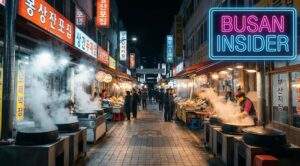
The Busan Pilgrimage: Seomyeon Dwaeji Gukbap Alley
If you are planning a trip to Korea, eating Dwaeji Gukbap in Seoul is acceptable, but eating it in Busan is mandatory. It’s like eating deep-dish pizza in Chicago vs. Miami.
The Location: Seomyeon Dwaeji Gukbap Alley (서면 돼지국밥 골목).
This is a narrow street packed with steaming cauldrons.
-
Logistics: Take the KTX from Seoul to Busan ($45 USD / 59,800 KRW). It takes about 2.5 hours.
-
Navigation: Copy/Paste this into Naver Map: 서면 돼지국밥 골목.
-
Recommended Spot: Songjeong 3-dae Gukbap (송정3대국밥). They have been open since 1946. It’s gritty, loud, and delicious.
Financial Tip: Most places here charge about 9,000 KRW ($6.75 USD). You can pay with your WOWPASS or a US Credit Card (Visa/Mastercard) without issues. No tip is required.
Logistics & Finance FAQ
1. Is Dwaeji Gukbap spicy?
No. By default, it is white and mild. It only becomes spicy if you add the red paste (Dadaegi) or Kimchi juice.
2. Can I eat the tiny shrimp (Saeujeot) raw?
Yes. They are fermented and highly salted. They are safe to eat and essential for seasoning the soup.
3. Is this safe for people with gluten allergies?
Generally, yes. The broth is bone and water. The rice is gluten-free. However, check the Kimchi and the red paste (Dadaegi) as some commercially made pastes may use wheat flour as a thickener. To be 100% safe, stick to the white broth, salted shrimp, and rice.
4. Do US Credit Cards work at local Gukbap joints?
In 2026, yes. Even small “mom and pop” shops in Busan accept foreign Visa/Mastercards. However, having 50,000 KRW ($38 USD) in cash is always smart for older markets.
5. Is it better to buy the pouch or make it from scratch?
Buy the pouch. Making authentic Gukbap requires soaking bones to remove blood, boiling for 12 hours, and skimming fat constantly. The gas bill alone costs more than the pouch.
The Verdict: Stop Overpaying for Ramen
Dwaeji Gukbap offers a superior value proposition to Tonkotsu Ramen. It provides higher quality protein, cleaner ingredients, and a lower price point, whether you are dining in Busan or buying a pouch at a US H-Mart.
Next Step for You:
Go to your local H-Mart or Amazon this weekend, pick up a Bibigo Pork Soup pouch, and try the “Saeujeot” seasoning hack yourself. Your gut (and your wallet) will thank you

Hi, I’m Dokyung, a Seoul-based tech and economy enthusiast. South Korea is at the forefront of global innovation—from cutting-edge semiconductors to next-gen defense technology. My mission is to translate these complex industry shifts into clear, actionable insights and everyday magic for global readers and investors.