
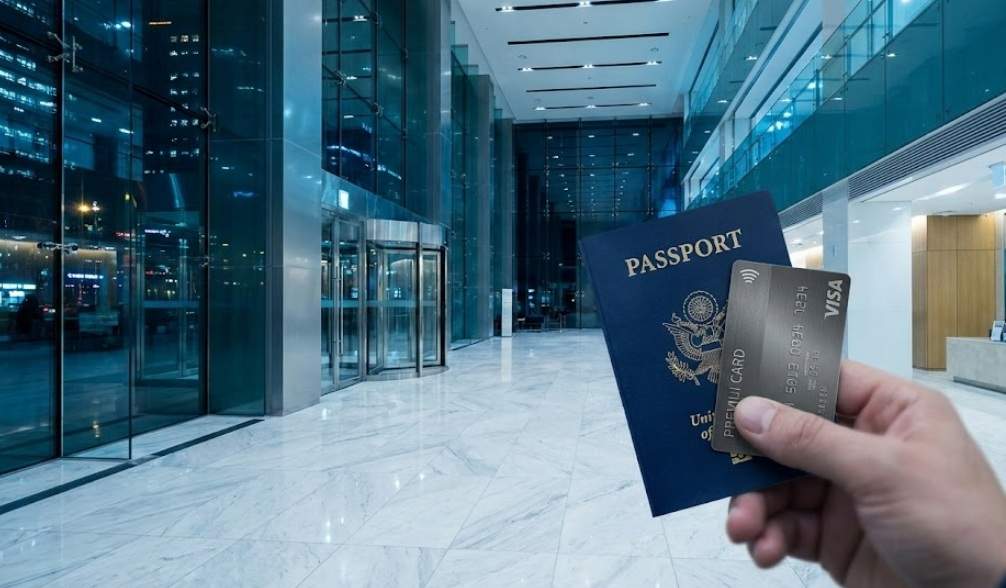
Getting Sick in Seoul: ER Costs, $20 Clinics & Why You Need Travel Insurance
Let’s be real for a second. You’ve budgeted for the flight, the Han River Airbnb, and an embarrassing amount of K-BBQ. But have you budgeted for the stomach flu?
Here is the hard truth your travel brochure won’t tell you: While South Korea has one of the world’s most efficient healthcare systems, it is not free for tourists.
As an American, you are likely traumatized by US healthcare costs (I get it, a $2,000 ambulance ride is a nightmare). In Korea, the sticker shock goes the other way—it’s surprisingly affordable—but only if you know the rules. If you walk into a University ER for a simple cold, you will burn through your shopping budget in 30 minutes.
This guide isn’t just about safety; it’s about financial self-defense. I’m going to show you how to navigate Korean healthcare like a local, where to get treated for the price of a takeout meal, and why spending $30 USD on travel insurance now is smarter than risking a $500 USD bill later.
US vs Korea Healthcare Cost: The Ultimate Price Cheat Sheet
Comparison of Non-Insured / Tourist Prices
If you take nothing else from this article, memorize this table. This is the “Price of Admission” for medical care in Seoul without Korean National Health Insurance (NHI).
| Category / Item | Price in Korea (USD / KRW) | US Equivalent Price (Avg) | Where to Go (Naver Map Search) |
| Local Clinic Visit (Cold/Flu) | $15 – $25 USD (20,000 – 35,000 KRW) | $150 – $200 USD (Urgent Care) | 내과 (Internal Medicine) |
| Emergency Room (ER) | $110 – $375 USD (150,000 – 500,000 KRW) | $2,000+ USD (Facility Fee) | 응급실 (Emergency Room) |
| Ambulance Ride | $0 USD (Free via 119) | $1,200+ USD | Call 119 |
| MRI Scan | $350 – $600 USD (450k – 800k KRW) | $1,500 – $4,000 USD | University Hospital |
| Prescription Meds | $3 – $10 USD (4,000 – 13,000 KRW) | $20 – $100 USD | 약국 (Pharmacy) |
Pro Tip: Unlike the US where you get billed weeks later, Korea requires payment immediately upon discharge. You cannot leave the hospital until the bill is settled. This is why having a high-limit credit card or travel insurance is non-negotiable.
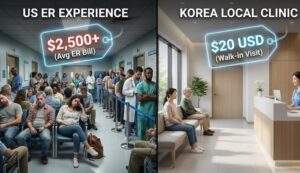
Emergency Room Cost Korea: What Tourists Pay Without Insurance
Let’s tackle the biggest financial fear first. If you trip on a hike at Bukhansan or get severe food poisoning from street food, you are heading to the ER.
Featured Snippet:
For a non-resident tourist without insurance, a basic Emergency Room visit in Seoul typically costs between $110 USD (150,000 KRW) and $375 USD (500,000 KRW). This covers the facility fee, basic consultation, and IV fluids.
If your condition requires advanced imaging (CT Scan or MRI) or overnight observation, your bill can easily exceed $750 USD (1,000,000 KRW).
The “University Hospital” Premium
In Korea, the best hospitals are usually attached to universities (like Yonsei Severance or Seoul National University Hospital). These are the “Ivy Leagues” of medicine.
-
The Cost: They charge a “foreigner surcharge” or higher administrative fees.
-
The Wait: Expect to wait 2–4 hours unless you are literally dying.
-
The Payment: Many large hospitals have an “International Clinic” meant for foreigners, but they often charge 2x–3x more than the regular wards.
Financial Verdict: Only go to the ER for true emergencies (broken bones, severe pain, breathing issues). For everything else, use the “Local Clinic” strategy below to save 90% of your money.
The “K-Speed” Secret: Local Clinics vs. US Urgent Care
In the US, if you feel sick, you debate going to Urgent Care because of the co-pay. In Korea, you just go to the local clinic (Uiwon).
Think of these clinics as the “7-Eleven” of healthcare—they are on every corner, they are fast, and they are cheap.
How to Find a Cheap Clinic:
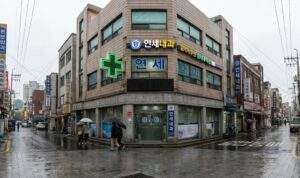
Do not search for “Hospital” on Google Maps. Instead, open Naver Map or KakaoMap and search for:
-
내과 (Nae-kwa): Internal Medicine (Stomach flu, colds, general sickness).
-
이비인후과 (I-bi-in-hu-kwa): Ear, Nose, and Throat (Sinus infections, sore throat).
-
정형외과 (Jeong-hyeong-oe-kwa): Orthopedics (Sprained ankles, muscle pain).
The Experience:
-
Walk-in: No appointment needed.
-
Speed: You will usually see a doctor within 15 minutes.
-
Cost: roughly $15 USD (20,000 KRW) for the consultation.
-
Treatment: Korean doctors love shots. You will likely get a shot in the buttock or an IV drip for fatigue.
Insider Money Tip:
Even without insurance, paying $20 USD cash here is cheaper than your co-pay back home. Keep the receipt! You can often claim this on your travel insurance later.
119 vs. 911: The Ambulance is Free (But There’s a Catch)
This is the biggest shock for Americans.
-
US: Call 911 -> Fear the $2,000 bill.
-
Korea: Call 119 -> It is 100% FREE, even for tourists.
The Catch:
-
Language: The EMTs might not speak English.
-
Destination: They will take you to the nearest hospital, not necessarily the one with the best English-speaking staff or International Center.
The Solution:
If you are conscious and stable, call 1339 (Korea Disease Control & Prevention Agency) first. They offer medical interpretation services in English and can help you communicate with the 119 dispatcher or tell you which hospital has an English speaker on duty.
Seoul Travel Insurance Guide: Why US Policies Fail Here
You might be thinking, “If clinics are only $20, why do I need insurance?”
Because if you need an appendectomy, a broken leg surgery, or medical evacuation, the cost jumps from $20 to $10,000+. US domestic health insurance (Blue Cross, Aetna, Medicare) rarely covers you internationally, or they work on a “reimburse later” basis with massive out-of-network deductibles.
Here is how to shop for insurance based on your travel style. Do not overspend on features you don’t need.
1. The “Adventure Traveler” (Best for Hikers/Partiers)
-
Top Pick: World Nomads
-
Why: They cover “high-risk” activities. If you plan on hiking Hallasan or partying hard in Hongdae (where accidents happen), this is the standard.
-
The Perk: You can buy it after you’ve already left the US (most companies require you to be home to buy).
2. The “Digital Nomad” (Long-term Stays)
-
Top Pick: SafetyWing
-
Why: It’s a subscription model (like Netflix). You pay roughly $45 USD/month.
-
The Perk: It covers you in Korea and almost anywhere else you go next. It’s perfect if you’re doing a 3-month “workation” in Seoul.
3. The “Comfort Seeker” (Families/Higher Budget)
-
Top Pick: GeoBlue (by Blue Cross)
-
Why: They have the best network of doctors who bill the insurance company directly.
-
The Perk: Direct Billing. This means you don’t have to pay the $500 USD upfront at the ER and fight for a refund later. They handle the payment with the hospital.
Warning: Always print your insurance policy or save a screenshot of the “Emergency Assistance” phone number on your phone. Korean hospital admins will want to see proof of coverage immediately.
Pharmacies & OTC Meds: The “Yakguk” Strategy
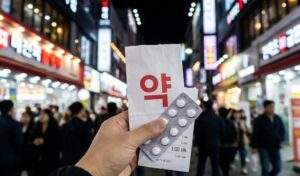
Buying medicine in Korea is a cultural experience. Pharmacies are marked with a big “약” (Yak) sign.
VS. The US Model:
-
US: You buy a bottle of 500 Tylenol at Costco.
-
Korea: You buy a blister pack of 10 pills.
Price Comparison:
-
Painkillers (Tylenol/Advil): $2.50 USD (3,000 KRW) for 10 pills.
-
Cold Medicine (Theraflu style): $3.50 USD (5,000 KRW).
-
Patches (Pasu): Korea is famous for muscle pain patches. $3.00 USD (4,000 KRW) for a pack. Better than IcyHot.
Can’t find a Pharmacy at night?
Go to any Convenience Store (CU, GS25, 7-Eleven). They sell basic “Safe Household Medicines” (Tylenol, digestion medicine, patches) 24/7. Look for the small medical shelf near the counter.
Logistics & Finance FAQ: Your Wallet’s Safety Net
Q: Will my US Credit Card work at Korean hospitals?
A: Yes. Virtually all hospitals and clinics accept Visa and Mastercard. However, verify your card has no foreign transaction fees (like Chase Sapphire or Capital One). If you use a standard debit card, you’ll get hit with a 3% fee on top of the medical bill.
Q: Do I need to tip the doctor or nurse?
A: Absolutely not. Tipping is not a culture in Korea, and in a medical setting, it can be seen as a bribe or insult. Keep your cash.
Q: How do I get reimbursed by my insurance if I pay upfront?
A: You must ask the hospital for a “Medical Certificate” (Jin-dan-seo) and a “Detailed Receipt” (Yeong-su-jeung) in English.
-
Note: Hospitals often charge a small fee ($10-$15 USD) to issue these documents in English. Pay it—you need these papers to file your claim back home.
Q: Can I buy antibiotics over the counter?
A: No. Korea is very strict with antibiotics. You must see a doctor (pay the $20 consult fee) to get a prescription. You cannot just buy them at the pharmacy like in some other countries.
Q: Is the tap water safe to drink for US stomachs?
A: Technically, yes, Seoul tap water is clean. However, the pipes in older buildings can be rusty. Most locals drink filtered water or bottled water. Bottled water is cheap ($0.75 USD for 2 Liters). Don’t risk a stomach bug to save 75 cents.
Conclusion: Don’t Let a Bill Ruin the BBQ
Here is the bottom line: Korea is one of the safest places in the world to be a tourist, but it is also a place where cash is king in medical situations.
You are coming here to spend your money on skincare, K-Pop merch, and Hanwoo beef—not on a hospital administration fee because you didn’t have insurance.
-
Buy the Travel Insurance (It’s the price of one BBQ meal).
-
Download Naver Map and save the search term “내과” (Internal Medicine).
-
Know your 1339 number.
Travel smart, spend wisely, and stay healthy so you can eat everything in sight.
Welcome to Seoul.

Hi, I’m Dokyung, a Seoul-based tech and economy enthusiast. South Korea is at the forefront of global innovation—from cutting-edge semiconductors to next-gen defense technology. My mission is to translate these complex industry shifts into clear, actionable insights and everyday magic for global readers and investors.