
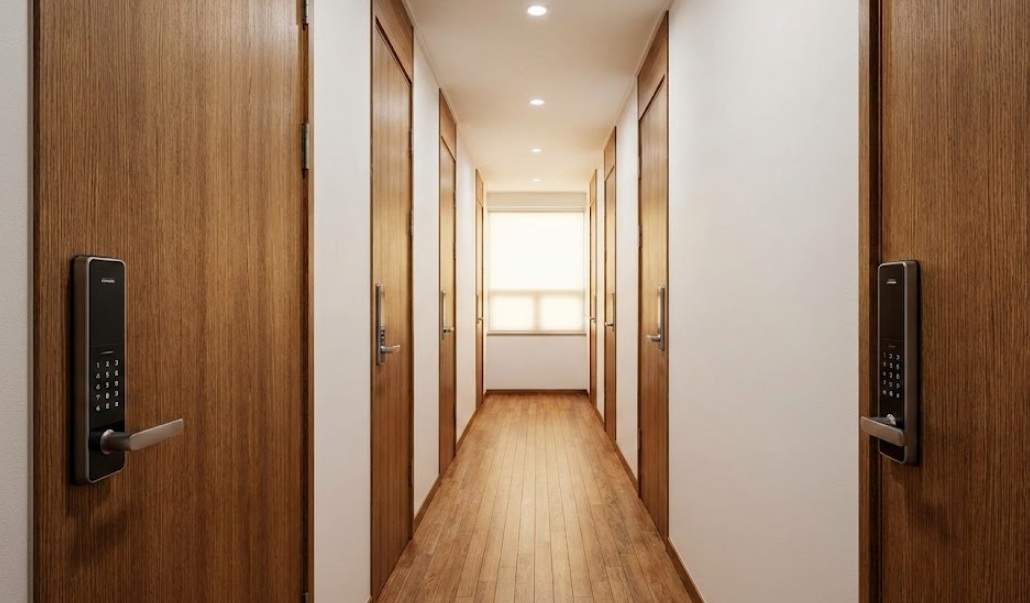
Master Goshiwon life in Korea: The Unspoken Code of Thin Walls, Free Rice, and Perfect Nunchi.
So, you’ve seen the photos. A room so small you can touch both walls at once, a bed that doubles as a desk, and a price tag that feels too good to be true for central Seoul. Welcome to the Goshiwon (고시원) life.
Most travel blogs will tell you it’s a “budget-friendly accommodation for students.” That’s the sanitized version. As a Seoul local, I’m going to give you the “Hyung/Unnie” truth: A Goshiwon isn’t just a room; it’s a high-stakes social contract. In a place where walls are thin enough to hear your neighbor’s heartbeat, etiquette is your only survival tool. If you treat a Goshiwon like a hostel or an Airbnb, you will be miserable, and the manager will likely ask you to leave. But if you master the “Goshiwon Code,” you’ll save thousands of dollars and live in the heart of Gangnam or Hongdae for the price of a few dinners.
Let’s get you ready for the micro-life.
The “Goshiwon Survival” Cheat Sheet
| Category | The Local Rule | Pro-Tip for Foreigners | Must-Have Item |
| Noise (소음) | Total silence 10 PM – 8 AM | No phone calls in the room | Noise-Canceling Headphones |
| Kitchen (주방) | Wash dishes instantly | Use your own “Ramen Pot” | Personal Dish Soap/Sponge |
| Food (식사) | Rice/Kimchi is free for all | Never take someone else’s Tupperware | Microwave-safe containers |
| Trash (쓰레기) | Strict 5-way separation | Check the “Trash Calendar” | Small desk bin (keep it dry) |
| Visitors (외부인) | STRICTLY PROHIBITED | Meet friends at a Cafe | A good data plan / eSIM |
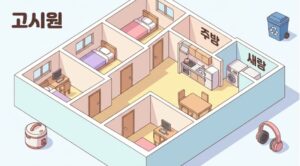
[Related Posts: Living in a Seoul Goshiwon: How to Thrive in Korea’s Cheapest Micro-Apartments]
1. The “Wall Noise” (Byeok-gan-soeum) Battle
In Korea, we have a specific word for the nightmare of Goshiwon life: Byeok-gan-soeum (벽간소음)—noise between walls.
Most Goshiwons are built with ALC blocks or even plywood. You are not living in a soundproof bunker. If you laugh out loud at a YouTube video at 11 PM, the guy next door hears it like you’re sitting on his bed.
-
The Golden Rule: If you can hear them, they can hear you. Use Bluetooth headphones for everything—gaming, Netflix, even taking a Zoom call.
-
The Phone Call Protocol: Do not take long calls in your room. Go to the rooftop or the stairwell. Koreans view the Goshiwon as a “sleeping-only” zone.
-
The Keyboard Stealth: If you’re a digital nomad, invest in a “silent” mouse and keyboard. The click-clack at 2 AM is the fastest way to get a “Warning Note” stuck to your door.
Pro-Tip: If your neighbor is being loud, do not knock on their wall. This is considered an aggressive confrontation. Instead, send a polite KakaoTalk message to the manager (관리자) or leave a note on the communal whiteboard.
2. The Kitchen & The “Free Food” Etiquette
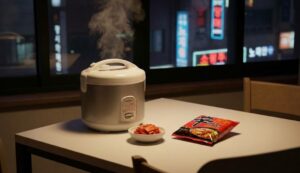
One of the best perks of Goshiwon life is the free rice (밥), Kimchi (김치), and sometimes Ramen (라면) or eggs. But “free” doesn’t mean “chaos.”
The Rice Cooker Logic
The communal rice cooker is the heart of the Goshiwon.
-
Don’t take the last scoop: If you see only a tiny bit of rice left, it’s polite to start a new batch or at least notify the manager.
-
Clean the paddle: Don’t leave the rice scoop covered in dried grains. Rinse it and put it back in the water container.
The “Immediately” Rule
In a kitchen shared by 20 people, you cannot leave a single fork in the sink. The smell of cooking—especially strong scents like bacon or heavy spices—lingers in small hallways.
-
Sensory Detail: You’ll notice the faint, constant scent of cooked white rice and fermented Kimchi in the halls. It’s the “Goshiwon Scent.” Try to avoid adding “burnt garlic” to that mix.
Pro Tip: Ask for an apron or a place to keep your supplies by saying: “Sujat-garak eodi isseoyo?” (숟가락 어디 있어요? – Where are the spoons/utensils?) though most locals bring their own set to stay hygienic.
[related post: The $0 Deposit Housing Bible: How to Book a Seoul Goshiwon Like a Local Insider]
3. The “Bun-ri-su-geo” (Recycling) Gauntlet
If you want to make the “Ajumma” (the landlady/manager) love you, master the trash. If you mess this up, she will find you. Koreans take recycling with religious seriousness.
You cannot just throw everything into one bag. You must separate:
-
Plastic (플라스틱): Must be rinsed. No food residue!
-
Paper (종이): Flatten all boxes.
-
Vinyl/Wrappers (비닐): Clean snack bags and plastic wrap.
-
Food Waste (음식물 쓰레기): This is the tricky one. This goes in a specific bin (usually orange or yellow). Never put food in the regular trash.
-
General Waste (일반 쓰레기): Everything else.
Search on Naver Map: Look for “Pyeonuijeom” (편의점) to buy official city trash bags (Jong-ryang-je bong-tu) if your Goshiwon doesn’t provide them for your private room.
4. Platform Arbitrage: How to Move Like a Local
Stop using Google Maps. It doesn’t work well for the narrow alleys where Goshiwons are hidden.
-
Naver Map (네이버 지도): Essential. Use it to find the nearest “Coin Laundry” (코인세탁소) because Goshiwon dryers are often weak or non-existent.
-
Kakao T: If you’re moving in with two big suitcases, don’t try the subway. Book a “Venti” (large taxi) on Kakao T.
-
Catchtable (캐치테이블): Goshiwon rooms are too small for “hosting.” Use Catchtable to book a nice restaurant nearby when you need to breathe and socialize.
5. Cultural Context: The Concept of “Jeong” and “Nunchi”
Why are the rules so strict? It’s about Nunchi (눈치)—the art of sensing others’ feelings and maintaining harmony. Because you are living in such close quarters, your “Nunchi” must be at 100%.
You might not see your neighbors often, but you are all sharing a collective “Jeong” (social bond) by keeping the space quiet and clean for each other.
-
The Resident Manager: Treat the manager with immense respect. A small gift (like a set of Vitamin C drinks from a convenience store) goes a long way. If they like you, they might give you a room with a slightly bigger window or a newer AC unit.
6. Laundry & Shower Etiquette
If your Goshiwon has a shared bathroom (common in older ones), the “Shower Caddy” is your best friend.
-
The 15-Minute Rule: Don’t linger. A Goshiwon shower is for utility, not a spa day.
-
Laundry Timing: Never leave your clothes in the communal washing machine after the cycle ends. People will move your wet clothes onto the table (or the floor) if you’re not there. Set a timer on your phone.
Pro Tip: Look for a Goshiwon that labels itself as a “Goshitel” (고시텔) or “One-room-tel” (원룸텔). These usually have a private shower/toilet in the room, which is worth the extra 100,000 KRW for your mental health.
7. Safety and Hidden Traps
-
The Window Trap: A room with no window (“Naechang” – 내창) is cheaper but can lead to depression and mold issues. Always aim for a room with a window facing outside (“Oechang” – 외창).
-
The Deposit: Most Goshiwons require a small deposit (usually 50,000 to 100,000 KRW). Ensure you get a receipt.
-
Check for “Soseol” (Fire Safety): Ensure there is a fire extinguisher and a working flashlight in your room.
Conclusion: Is Goshiwon Life For You?
Living in a Goshiwon is a rite of passage in Korea. It’s a lesson in minimalism, respect, and the incredible efficiency of Korean urban design. It’s not always “beautiful,” but it’s authentic. You’ll save money, stay in the heart of the action, and learn more about Korean society in a month than a tourist does in a year.
Respect the silence, master the trash, and keep your Nunchi sharp.
Welcome to the neighborhood!

Hi, I’m Dokyung, a Seoul-based tech and economy enthusiast. South Korea is at the forefront of global innovation—from cutting-edge semiconductors to next-gen defense technology. My mission is to translate these complex industry shifts into clear, actionable insights and everyday magic for global readers and investors.