
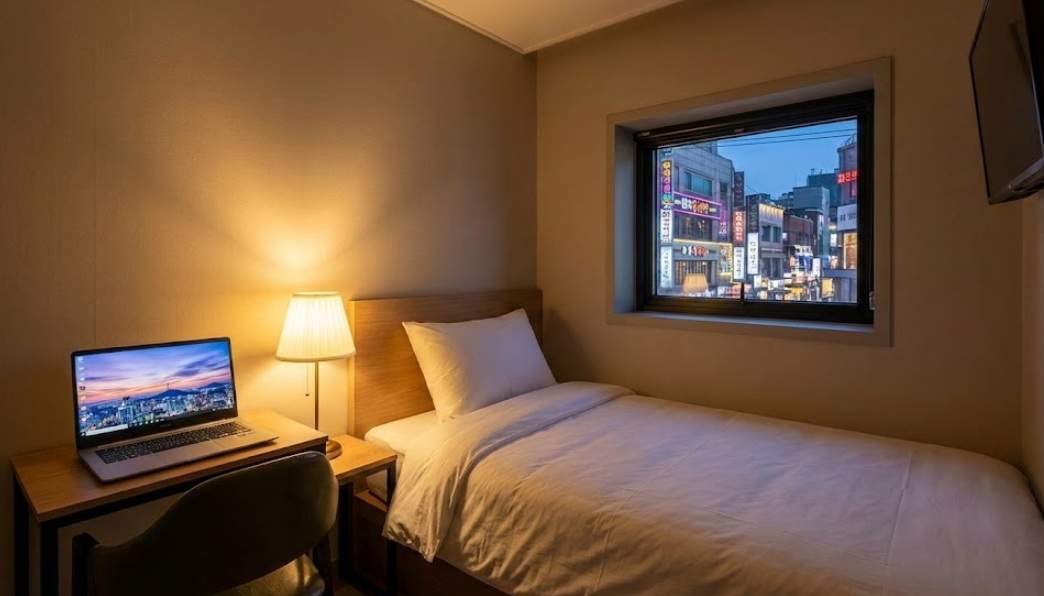
Living in a Seoul Goshiwon: The Brutal Truth About 30 Days in a Micro-Room
So, you’ve looked at Airbnb prices in Hongdae and realized they cost more than your flight. Or maybe you’ve looked into “One-rooms” (원룸) and found out you need a $5,000+ deposit just to get the keys.
Welcome to the Seoul housing reality.
Most tourists get stuck in overpriced hotels or cramped hostels. But if you want to stay for a month or more without draining your bank account, there is a “secret” every Korean student and budget-savvy local knows: The Goshiwon (고시원).
Before you click away thinking these are just “coffin rooms” from a horror movie, let’s get real. While they are small—very small—the modern Goshiwon (often called a Goshitel) is the ultimate life hack for foreigners. It’s a private room, usually with no deposit, free utilities, and—get this—unlimited free rice, ramen, and kimchi.
In this guide, your “Seoul Hyung” is going to show you how to navigate this unique world, avoid the “basement traps,” and live like a local in the heart of the city.
The Korean Housing Cheat Sheet
| Feature | Classic Goshiwon (고시원) | Premium Goshitel (고시텔) | One-room (원룸) |
| Monthly Rent | ₩300,000 – ₩450,000 | ₩500,000 – ₩800,000 | ₩600,000+ |
| Deposit | None (or ₩50k-100k) | None (or ₩100k) | ₩5,000,000+ |
| Bathroom | Shared down the hall | Private (En-suite) | Private |
| Free Food? | Yes (Rice/Ramen/Kimchi) | Usually Yes | No |
| Best For | Extreme Budget Travelers | Digital Nomads / Solo Travelers | Long-term Residents (1yr+) |
| Naver Map Search | 고시원 | 프리미엄 고시텔 | 원룸 |

[related post: Master Goshiwon life in Korea: Local Secrets to Micro-Living in Korea]
1. What Actually is a Goshiwon? (The Local Truth)
Historically, Goshiwons were “exam rooms” for students cramming for the bar exam (Goshi). They needed a place with zero distractions, no noise, and zero commute.
Today, they’ve evolved. While some older ones are still “gritty,” a new wave of “Premium Goshitels” has taken over. These are essentially micro-boutique hotels. You get a bed, a desk, a mini-fridge, a wardrobe, and your own tiny bathroom all packed into about 6 to 10 square meters.
Pro Tip: If you see the word “One-room-tel” (원룸텔), it usually means the room has its own private shower and toilet. If it just says “Goshiwon,” double-check if the bathroom is shared!
2. Platform Arbitrage: How to Find the Good Ones
Don’t rely on Google Maps. It’s outdated and won’t show you the newest spots. To find a place that doesn’t feel like a dungeon, use these tools:
-
Naver Map (네이버 지도): Search for “고시원” or “고시텔” in the neighborhood you want. Look at the photos—locals upload “real” photos here.
-
Goshipages: The most foreigner-friendly website. It’s in English and allows you to message managers directly.
-
Stayes / Stay Korea: Great for slightly higher-end, managed “living spaces” that are foreigner-friendly.
-
KakaoTalk (카카오톡): Once you find a place, look for their KakaoTalk ID. Most managers prefer chatting over a phone call, especially if your Korean is limited. You can use a translator to say: “한 달 거주 가능한가요?” (Is a one-month stay possible?)

3. Choosing Your Neighborhood (Dong)
Where you live in Seoul changes your entire experience. Here is the local breakdown:
Hongdae / Sinchon (홍대 / 신촌)
The heartbeat of Seoul’s youth culture.
-
Vibe: Busking, clubs, cheap eats, and endless energy.
-
Why here: You’ll find many “Foreigner-only” Goshiwons here because of the nearby universities (Yonsei, Ewha, Hongik).
Gangnam (강남)
The “glitz and glam” side of the river.
-
Vibe: Skyscraper views, high-end cafes, and professionals in suits.
-
Why here: If you are a digital nomad, Goshiwons here are often more modern and “business-like,” though slightly more expensive.
Hoegi / Anam (회기 / 안암)
The “Student Secret.”
-
Vibe: Local, quiet, and incredibly cheap.
-
Why here: Because these areas serve Kyunghee and Korea University, the prices are some of the lowest in Seoul, and the food in the neighborhood is “Student Price” (very affordable).
4. The “Unspoken Rules” of Goshiwon Life
Living in a Goshiwon is a social contract of silence. Koreans value “Nunchi” (the art of reading the room).
-
The Sound Wall: The walls are often thin. You shouldn’t take phone calls in your room late at night. Most people go to the roof or the common kitchen.
-
The Kitchen Etiquette: The rice and ramen are free, but you must wash your own dishes immediately. Leaving a dirty bowl in the sink is the fastest way to get a “warning” from the Ajumma (manager).
-
No Guests: 99% of Goshiwons strictly forbid guests. It’s for safety and noise control. If you want to hang out with friends, go to a “PC Bang” (PC Cafe) or a “Multi-room.”
“Hyung’s” Warning: Always ask to see the room in person before paying. Check the window. A room with an “outer window” (looking outside) is much better for your mental health (and ventilation) than an “inner window” (looking into the hallway). It usually costs ₩50,000 more, but it’s worth every won.
[related post: The $0 Deposit Housing Bible: How to Book a Seoul Goshiwon Like a Local Insider]
5. Sensory Details: What It Feels Like
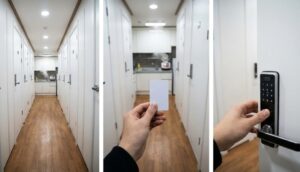
Walking into a Goshiwon for the first time is a sensory experience. You’ll likely smell Sesame Oil and freshly cooked rice wafting from the communal kitchen. The hallways are usually narrow and lined with shoes (always change into the provided indoor slippers!).
At night, it’s remarkably quiet—a strange contrast to the neon-soaked, loud streets of Seoul just outside the front door. You’ll hear the faint hum of your mini-fridge and the “beep-beep-beep” of digital door locks clicking throughout the building.
6. Survival Gear: The “Landing Kit”
When you move in, the room will be empty except for the furniture. Head to the nearest Daiso (다이소)—the ultimate survival shop for Koreans.
Pick up these items immediately:
-
Hanging Organizers: Since floor space is non-existent, use the walls.
-
Febreze: Small rooms can get stuffy quickly.
-
Noise-canceling headphones: Your best friend for sleeping or working.
-
T-Money Card: For the subway/bus (usually available at the GS25 or CU convenience store on the first floor of your building).
7. How to Book (The Step-by-Step)
-
Filter by Location: Pick your ‘Dong’ (neighborhood) on Naver Map.
-
Contact via KakaoTalk: Send a message asking about availability for your dates.
-
The “Briefing”: The manager will show you the room, the kitchen, and the laundry room (usually free detergent is included!).
-
Payment: You usually pay the first month upfront. Some ask for a small “Key Deposit” (₩50,000 – ₩100,000) which you get back when you leave.
-
No Contract Hassle: Unlike apartments, there is usually no complex paperwork. You give a copy of your passport, pay, and you’re in.
Conclusion: Is it for you?
Living in a Goshiwon for a month isn’t about luxury; it’s about freedom. By spending only ₩450,000 on rent, you have more money for K-BBQ, weekend trips to Busan, and shopping in Myeongdong. It’s a rite of passage for many in Korea and a way to experience the “real” Seoul that most tourists never see.
You’ll learn to live minimally, appreciate the community of the shared kitchen, and have a home base in the most exciting city in the world.

Hi, I’m Dokyung, a Seoul-based tech and economy enthusiast. South Korea is at the forefront of global innovation—from cutting-edge semiconductors to next-gen defense technology. My mission is to translate these complex industry shifts into clear, actionable insights and everyday magic for global readers and investors.