
Why Wall Street is Wrong About Samsung: The 2026 “Price War” Catalyst They Are Overlooking
If you listen to the talking heads on CNBC, the semiconductor race is already over. NVIDIA and TSMC won, Intel failed, and Samsung is just “that company that makes Galaxy phones.”
But here in Pyeongtaek—ground zero for Korea’s semiconductor industry—the whisper numbers tell a different story. While Wall Street is hyper-focused on TSMC’s dominance today, they are missing the massive shift happening in 2026.
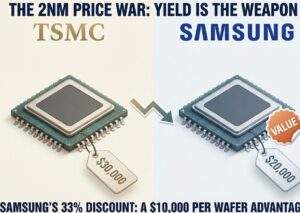
Think of it this way: TSMC is the “Neiman Marcus” of chips—premium quality, but you pay a premium price (about $30,000 USD per wafer). Samsung is positioning itself as the “Costco” for the next AI wave—offering comparable 2nm tech at $20,000 USD, a 33% discount.
With the new Taylor, Texas fabrication plant finally set for mass production in 2026, Samsung isn’t just a Korean stock anymore. It’s becoming a “Made in USA” infrastructure play. Here is the insider breakdown of why the smart money is quietly accumulating shares before the Taylor ribbon-cutting ceremony.
The “Korea vs. US” Investment Cheat Sheet
Your quick guide to buying the dip before the 2026 breakout.
| Feature | Samsung Electronics (Korea) | US Equivalent / Option | Insider Notes |
| Primary Ticker | 005930.KS (KOSPI) | SSNLF (OTC / Pink Sheets) | The Korean ticker is the “Real” stock. SSNLF is the US “receipt” version. |
| Safe Buy Method | Direct Account (Hard) | EWY (ETF) | EWY gives you ~20% Samsung exposure without the paperwork headache. |
| Risk Level | Moderate | High (Liquidity issues) | buying SSNLF can have wide “spreads” (price gaps). Always use Limit Orders. |
| Wafer Price (2nm) | $20,000 USD (~28M KRW) | TSMC: $30,000 USD | This 33% discount is Samsung’s “Killer App” for 2026. |
| Local Search | 삼성전자 (Samsung Electronics) | Samsung GDR | Search 삼성전자 주가 on Naver for real-time local sentiment. |
The “Price War” Thesis: Undercutting TSMC by 33%
The biggest bearish argument against Samsung has been “Yield Rate” (how many usable chips you get per wafer). Historically, TSMC has been the king of efficiency. But the tide is turning.
Local reports from Chosun Daily and TrendForce indicate Samsung’s 2nm yield rates have quietly hit 55-60%, with targets to reach 70% by late 2025. Why does this matter? Because once they hit that stability, their pricing strategy becomes a weapon.
-
TSMC 2nm Wafer: ~$30,000 USD
-
Samsung 2nm Wafer: ~$20,000 USD
The “Wallet” Perspective:
If you are Elon Musk (Tesla) or Mark Zuckerberg (Meta) and you need millions of AI chips, that $10,000 difference per wafer adds up to billions in savings. Samsung is betting that big tech will diversify away from TSMC not just for geopolitical safety, but for the bottom line.
Pro Tip: Watch for news on the Exynos 2600 chip. This is the test subject. If the Galaxy S26 launches in early 2026 with a high-performing Exynos chip, it’s proof the 2nm yield issues are solved.
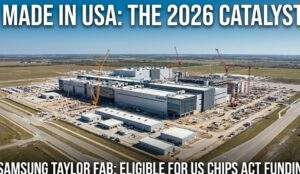
The Taylor, Texas Factor: The 2026 Catalyst
Construction delays in Taylor, Texas have depressed the stock price for two years. Wall Street hates delays. But the “Korea Insider” view is that this delay was strategic.
Instead of rushing to open a 4nm plant (which is already “old” tech), Samsung upgraded the facility to handle 2nm mass production.
-
Old Plan: Start 2024 with older tech.
-
New Plan: Mass production starts Q1/Q2 2026 with cutting-edge 2nm tech.
Why 2026 is the “Magic Number”:
The US “CHIPS Act” funding requires domestic production. By opening in 2026, Samsung becomes eligible for massive US government subsidies and becomes the primary alternative for US companies (AMD, Qualcomm) that must manufacture on US soil for national security contracts.
This plant changes Samsung from a “foreign importer” to a “local manufacturer” in the eyes of the US government.
Execution Guide: How to Buy Samsung Stock from the US
Buying Korean stocks isn’t as easy as opening Robinhood and tapping “Buy.” You have three main paths, ranked by difficulty.
Option A: The “Sleep Well at Night” Route (ETF)
Ticker: EWY (iShares MSCI South Korea ETF)
This is how 90% of US retail investors should play this. Samsung Electronics makes up roughly 20-22% of this ETF.
-
Pros: High liquidity, easy to buy/sell, pays dividends.
-
Cons: You also own other Korean companies (Hyundai, SK Hynix, etc.), so it’s not a “pure” bet.
-
Verdict: If you want exposure to the “Korea Discount” turnaround without the headache, buy EWY.
Option B: The “High Risk / Pure Play” Route (OTC)
Ticker: SSNLF (Pink Sheets)
This is a “Common Stock” trade on the Over-The-Counter market.
-
Pros: 100% Samsung exposure. If Samsung goes up 10%, this goes up 10% (roughly).
-
Cons: Extreme Liquidity Risk. The trading volume is low.
-
⚠️ CRITICAL WARNING: Never use a “Market Order” for SSNLF. The gap between the “Bid” (Buy) and “Ask” (Sell) price can be huge. You might accidentally pay 5% more than the current price. Always set a Limit Order at a specific price.
Option C: The “Pro” Route (London GDR)
Ticker: SMSN (London Stock Exchange)
If you have an international brokerage account (like Interactive Brokers or Fidelity International), you can buy Global Depositary Receipts (GDRs) listed in London.
-
Pros: Better liquidity than the US Pink Sheets.
-
Cons: Currency conversion fees (USD to GBP/USD) and higher commission fees.

Financial Forecast: The Valuation Gap
Let’s talk numbers. Samsung is currently trading at a P/E (Price-to-Earnings) ratio of around 17.9x (Forward 2025).
Compare that to the “Mag 7” US Tech stocks which trade at 30x – 50x.
-
Samsung P/E: ~17.9x
-
TSMC P/E: ~21x – 25x
-
Intel P/E: (Volatile/Unprofitable quarters)
The Upside:
If the Taylor plant executes correctly in 2026, analysts at Mirae Asset see the valuation gap closing. You are buying a top-tier AI hardware manufacturer at the price of a boring utility company.
Logistics & Finance FAQ
1. Does Samsung pay dividends to US investors?
Yes. Samsung is a dividend aristocrat in Korea. If you hold EWY, the dividends are distributed to you (minus fees). If you hold SSNLF, you receive the dividend, but your broker may deduct a foreign tax (usually 15% under the US-Korea tax treaty).
2. Is Samsung listing directly on the NYSE/NASDAQ soon?
No. There are rumors every year, but the Lee family (owners) prefers keeping control via the Korea Exchange (KRX). Do not wait for a US IPO; it’s not happening in 2026.
3. What is the biggest risk?
Yield Rate Failure. If the 2nm chips in 2026 have defects, major clients like Qualcomm will stay with TSMC. Follow the news on “Exynos 2600 Yields” closely.
4. Can I just buy the Korean stock directly?
Technically, yes, but it requires a “Foreign Investor Registration” which is a bureaucratic nightmare for individuals. It involves passport copies, proxy agreements, and specific banking setups. Stick to EWY or SSNLF.
5. How do I track the real price?
The US tickers often lag. To see what’s actually happening, search “삼성전자” on Google or Naver. If the Korean market (KOSPI) closed up 3%, expect SSNLF to open up ~3% the next morning.
Conclusion: The “Buy Before the Ribbon Cutting” Strategy
Wall Street loves to buy after the good news is confirmed. By the time the Taylor, Texas plant is cutting the red ribbon in 2026 and announcing a deal with Tesla or AMD, the stock will likely have already moved.
The “Korea Insider” play is to accumulate now, while the narrative is still “Samsung is struggling.” You are buying the $20,000 wafer disruptor at a discount.
Your Next Step:
Open your brokerage app and check the chart for EWY. If you see a dip due to general market fear, that is your entry point for the 2026 recovery.
Disclaimers: I am not a financial advisor. This is for informational purposes only. Investment in foreign stocks involves risk, including currency fluctuation.

Hi, I’m Dokyung, a Seoul-based tech and economy enthusiast. South Korea is at the forefront of global innovation—from cutting-edge semiconductors to next-gen defense technology. My mission is to translate these complex industry shifts into clear, actionable insights and everyday magic for global readers and investors.