
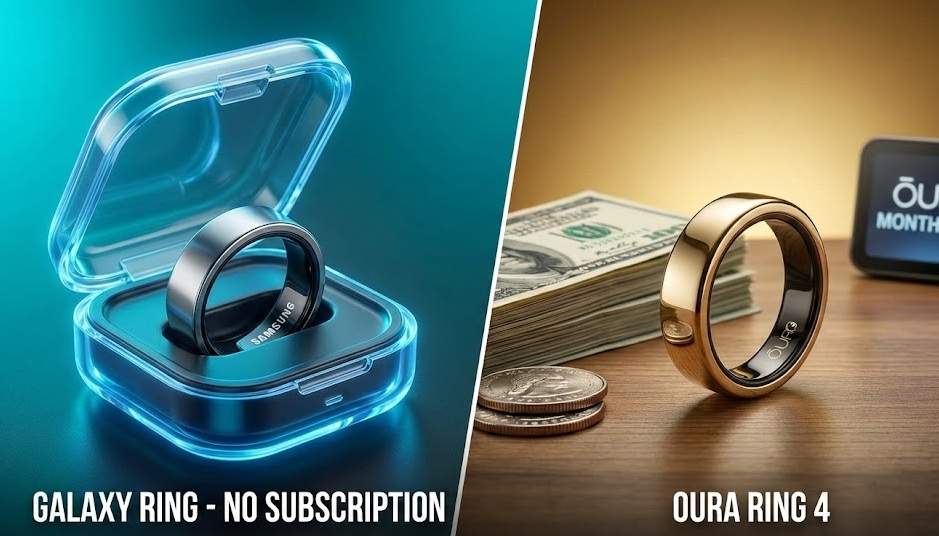
Galaxy Ring vs Oura Ring 4: The “Rent vs. Buy” Reality Check
Let’s be real for a second. You are already paying for Spotify, Netflix, Google Drive, and probably a gym membership you don’t use enough. Do you really want to pay a monthly rent just to see how well you slept last night?
I know why you are here. You want the sleek, invisible health tracking of a smart ring. You’ve heard Oura is the gold standard (and for a long time, it was). But you’ve also heard the rumors about the Samsung Galaxy Ring—the challenger that promises to liberate your wallet from the tyranny of monthly subscriptions.
In 2026, the smart ring market isn’t just about sensors; it’s about financial sense. Most reviews will bore you with specs. I’m going to show you the math that Oura doesn’t want you to see, and the one “travel feature” on the Galaxy Ring that makes the Oura charger look like ancient technology.
### The Quick Answer: Which is Cheaper?
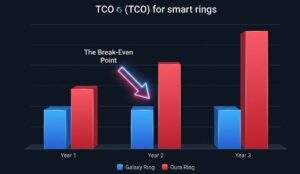
If you are an Android user, the Samsung Galaxy Ring is the undisputed financial winner. Despite a higher upfront cost ($399), it beats the Oura Ring 4 ($349 + subscription) in total cost after just 9 months.
Winner (Value): Samsung Galaxy Ring (Save ~$200+ over 3 years).
Winner (iOS/Deep Data): Oura Ring 4 (Still the only option for iPhone users).
The “Real Math” Table: Total Cost of Ownership (TCO)
The biggest lie in tech marketing is the “Starting Price.” Oura lures you in with a lower hardware cost, but the real price includes the “Gen 3/4 Membership” required to see anything beyond a simple score.
Here is the breakdown of what these rings actually cost you over their lifespan.
| Timeframe | Samsung Galaxy Ring ($399) | Oura Ring 4 ($349 + $5.99/mo) | The Difference |
| Upfront | $399.00 | $349.00 | Oura looks cheaper (-$50) |
| 1 Year | $399.00 | $420.88 | Galaxy wins by $21.88 |
| 2 Years | $399.00 | $492.76 | Galaxy wins by $93.76 |
| 3 Years | $399.00 | $564.64 | Galaxy wins by $165.64 |
Pro Tip: If you keep your ring for 3 years (standard for battery degradation lifecycles), buying an Oura Ring is effectively buying a $565 device. Is the sleep data really $165 better than Samsung’s? For 95% of users, the answer is no.
The Subscription Problem: What Do You Actually Lose?
This is the question that keeps buyers awake at night (ironically ruining their sleep score).
The Oura “Brick” Scenario
If you stop paying Oura the $5.99 monthly ransom, your advanced high-tech ring effectively gets lobotomized.
-
What you keep: Three simple daily scores (Readiness, Sleep, Activity).
-
What you lose: Deep sleep analysis, SpO2 (Blood Oxygen) monitoring, Heart Rate variability (HRV) trends, Temperature trends, and automatic activity detection.
-
The Reality: Without the sub, the Oura Ring 4 is just an overpriced pedometer.
The Samsung “Freedom” Model
As of early 2026, Samsung has aggressively kept the Samsung Health ecosystem free.
-
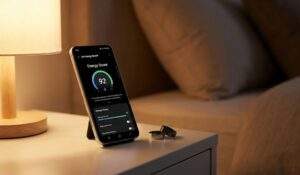
Energy Score: Samsung’s answer to Oura’s “Readiness.” It uses AI to analyze your sleep, activity, and heart rate to give you a daily score out of 100.
-
Cost: $0.
-
The Risk: There are rumors Samsung could introduce a “Samsung Health+” premium tier later. However, the Galaxy Ring’s core selling point is hardware purchase, so basic metrics will likely remain free to stay competitive.
Hardware & Charging: The “Travel Test” (The Unfair Advantage)
Most reviewers gloss over this, but if you travel, this is a Game Changer.
The Galaxy Ring: The “Earbud” Style Case
Samsung borrowed the best design element from their Galaxy Buds. The Ring comes with a clamshell charging case that has its own built-in battery.
-
Capacity: The case holds about 1.5 full charges for the ring.
-
The Vibe: You can throw the case in your bag for a weekend trip to Tokyo or New York without bringing a cable. You just pop the ring in the case at night, like earbuds.
-
Durability: It protects the ring when you take it off to lift weights or wash dishes.
The Oura Ring 4: The “Puck” Problem
Oura still uses a proprietary charging “puck” (cradle).
-
The Issue: It has no internal battery. It must be plugged into a USB-C cable to charge the ring.
-
The Annoyance: If you leave for a 3-day trip, you must pack the puck and a cable. If you lose the puck (which is small and slippery), you cannot charge your ring. A replacement puck costs ~$60.
Verdict on Design: The Galaxy Ring concave design prevents scratches better, and the charging case makes it the superior choice for travelers and digital nomads.
Data & Ecosystem: The Dealbreaker
Before you pull out your credit card, check your pocket. What phone is in there?
The “Walled Garden” of Samsung
Here is the hard truth: The Galaxy Ring does not support the iPhone.
It doesn’t matter how much money you save if the ring won’t talk to your phone. Samsung designed this ring to lock you into the Galaxy ecosystem (or at least the Android ecosystem). It works best with a Samsung Galaxy Watch, unlocking features like “double pinch” gestures to dismiss alarms.
Oura: The Agnostic King
Oura plays nice with everyone. Whether you have an iPhone 16 or a Pixel 10, the Oura app is beautiful, optimized, and data-rich.
-
Data Quality: Oura still holds the crown for sleep staging algorithms. Their years of data allow for slightly more nuanced “Chronotype” detection and illness prediction. If you are a bio-hacker who needs clinical-grade precision, Oura has the edge.
Verdict: Which One Deserves Your Finger?
We are done with the specs. Here is the decision matrix.
🚀 Buy the Samsung Galaxy Ring IF:
-
You use an Android Phone (especially Samsung). The integration is seamless.
-
You hate subscriptions. You want to pay once and own your data forever.
-
You travel frequently. The charging case is a massive quality-of-life upgrade.
-
You want “Set and Forget.” You want general health trends without paying a monthly bill.
[CTA: Check Current Galaxy Ring Price & Trade-in Deals]
💍 Buy the Oura Ring 4 IF:
-
You use an iPhone. (You have no other choice in the high-end ring market).
-
You are a Data Obsessive. You want the absolute best sleep tracking algorithm available.
-
Style is paramount. You prefer Oura’s specific finishes (like the Stealth or Gold Horizon).
-
You don’t mind the “Rent” model. $6/month is worth it to you for premium insights.
Insider FAQ
Q1: Does the Galaxy Ring work with iPhone in 2026?
A: No. Samsung has made it clear that the Galaxy Ring is an Android-exclusive peripheral, meant to strengthen the Galaxy ecosystem. There is no workaround app.
Q2: Is the Galaxy Ring truly subscription-free forever?
A: Currently, yes. However, tech giants often pivot. As of 2026, all features including Energy Score and Sleep Coaching are free. Samsung has stated they want to keep “core” features free, but “AI Premium” features could be paywalled in the future.
Q3: Which has better battery life?
A: The rings themselves are similar (6-7 days). However, the Galaxy Ring wins practically because the portable charging case extends your time away from a wall outlet to nearly 2 weeks (Ring + Case capacity).
Q4: Can I use the Oura Ring without a subscription?
A: Yes, but I strongly advise against it. Without the subscription, you only get three basic scores. You lose the trends, the cloud storage of historical data, and the detailed sleep stage graphs. It essentially becomes a dummy ring.
Q5: Which ring is more comfortable for sleeping?
A: Both are excellent, but the Oura Ring 4 (Horizon model) is perfectly round inside. The Galaxy Ring has a slightly concave outer shape but is also very light. Oura’s inner sensors are now recessed (flush) in the Gen 4, making it slightly more comfortable than older models with sensor bumps.

Hi, I’m Dokyung, a Seoul-based tech and economy enthusiast. South Korea is at the forefront of global innovation—from cutting-edge semiconductors to next-gen defense technology. My mission is to translate these complex industry shifts into clear, actionable insights and everyday magic for global readers and investors.