
🎯 Key Takeaways
- South Korea’s AI-powered surveillance market is not just advanced, it’s matured with a focus on data integrity, differentiating it from many Western approaches.
- Hanwha Techwin, now Hanwha Vision, has been instrumental in deploying integrated smart city security solutions that balance efficiency with privacy concerns.
- The global regulatory landscape for AI surveillance, especially regarding data governance, will heavily influence how quickly Korean ethical AI solutions gain broader international traction.
📋 Table of Contents
- ▸ Q1. Why the Global AI Surveillance Market is Rapidly Expanding, and Where Korea Stands
- ▸ Q2. How Korean Innovators Are Redefining Ethical AI-Powered Urban Security
- ▸ Q3. Leading the Charge: Who Are the Key Players in South Korea’s Smart City AI Ecosystem?
- ▸ Q4. What Are the Biggest Obstacles Blocking Global Adoption of Korean AI Surveillance?
- ▸ Q5. When Will Hanwha Techwin’s Integrated AI Solutions Achieve Wider Global Benchmarking?
The global conversation around AI-powered surveillance in urban environments often centers on a dichotomy: the promise of enhanced public safety versus the perils of privacy infringement. By the end of this article, you’ll understand why South Korea has quietly moved beyond this binary debate, how its innovators like Hanwha Techwin are leading the charge, and what specific advantages their integrated systems offer the world.
Q1. Why the Global AI Surveillance Market is Rapidly Expanding, and Where Korea Stands
The headline buried the most interesting part: the global market for AI video analytics in smart cities is experiencing exponential growth, projected to reach USD 28.76 billion by 2030, up from USD 8.50 billion in 2025, according to a MarketsandMarkets™ report published via PRNewswire in June 2026. This nearly three-fold expansion reflects an urgent demand for advanced tools to manage urban challenges, from traffic congestion and waste management to crime prevention and rapid emergency response.
As cities worldwide grapple with burgeoning populations and increasing complexity, AI-powered surveillance offers a compelling solution to enhance operational efficiency and public safety. Yet, many Western cities are still in the early stages of pilot programs or caught in protracted debates over ethical guidelines and data privacy. In contrast, South Korea, with its highly digitized infrastructure and dense urban centers, has spent over a decade quietly developing and deploying sophisticated, integrated AI surveillance systems, setting a practical benchmark for what’s possible.
South Korea’s journey into smart urban infrastructure began long before “smart city” became a global buzzword. Early investments in ubiquitous connectivity and digital governance laid the groundwork for advanced AI applications. This proactive approach has allowed Korean companies to develop mature solutions that address both the technical challenges of large-scale deployment and the complex societal concerns surrounding data use. It’s not just about installing cameras; it’s about building an intelligent, responsive urban nervous system.

Q2. How Korean Innovators Are Redefining Ethical AI-Powered Urban Security
While global cities are still experimenting, Korean innovators, particularly Hanwha Techwin (now operating as Hanwha Vision, a subsidiary of Hanwha Group), have spent years refining AI-powered surveillance South Korea smart cities solutions. Their approach emphasizes not just data collection, but intelligent processing at the edge, reducing the need for raw video feeds to leave local networks and enhancing privacy. Hanwha Vision’s total sales in 2020 reached 529.8 billion South Korean won, roughly $345.5 million USD at the current exchange rate of 1533.44 KRW/USD, underscoring their significant market presence even years ago.
These systems go beyond simple facial recognition. They incorporate advanced video analytics for anomaly detection, crowd management, traffic flow optimization, and even environmental monitoring. For instance, in cities like Incheon and Busan, Hanwha Vision’s integrated platforms analyze diverse data streams to predict potential incidents, allowing for proactive intervention rather than reactive responses. This shifts the paradigm from purely punitive surveillance to predictive urban management, enhancing efficiency across numerous public services.
This integration of sophisticated technology with a pragmatic approach to privacy is what truly sets Korean smart city technology apart. It’s about building trust through transparent data governance and ensuring that the benefits of AI in urban security are realized without compromising fundamental rights. This careful balance makes their offerings particularly attractive to municipalities seeking to navigate the complex ethical landscape. But who are the specific players making this happen on the ground?
| Feature | Hanwha Techwin (Korean Model) | Generic Western Approach (Est.) |
|---|---|---|
| Core Philosophy | Integrated public safety & data integrity; proactive urban management. | Reactive crime deterrence; often fragmented solutions; privacy as an add-on. |
| Data Processing | Heavy edge AI processing; anonymization at source; centralized analytics. | Cloud-centric; raw data often transmitted; anonymization often post-collection. |
| System Integration | Highly integrated VMS, IoT sensors, emergency services. | Often disparate systems; challenges with interoperability. |
| Deployment Maturity | Decade-long large-scale deployments in major cities. | Mostly pilot programs or localized deployments. |
| KoreaPlus Estimate: Global Ethical Adoption Readiness | High (est. 70-80% ready for stringent GDPR-like environments). | Moderate (est. 30-40% ready without significant re-engineering). |
How we got this: The KoreaPlus estimate for ‘Global Ethical Adoption Readiness’ is based on publicly available documentation of Hanwha Techwin’s privacy-by-design principles and their compliance with domestic data protection regulations, which are comparable in stringency to European GDPR standards.
Q3. Leading the Charge: Who Are the Key Players in South Korea’s Smart City AI Ecosystem?
While Hanwha Techwin is a prominent name, the Korean smart city AI ecosystem is deep, encompassing various specialized firms. Hanwha Techwin’s offerings span a comprehensive range of intelligent cameras, video management software (VMS), and integrated control platforms that leverage deep learning algorithms. Their Wisenet AI series, for example, can classify objects, detect abnormal behavior, and provide real-time alerts, significantly reducing the human workload for monitoring large urban areas.
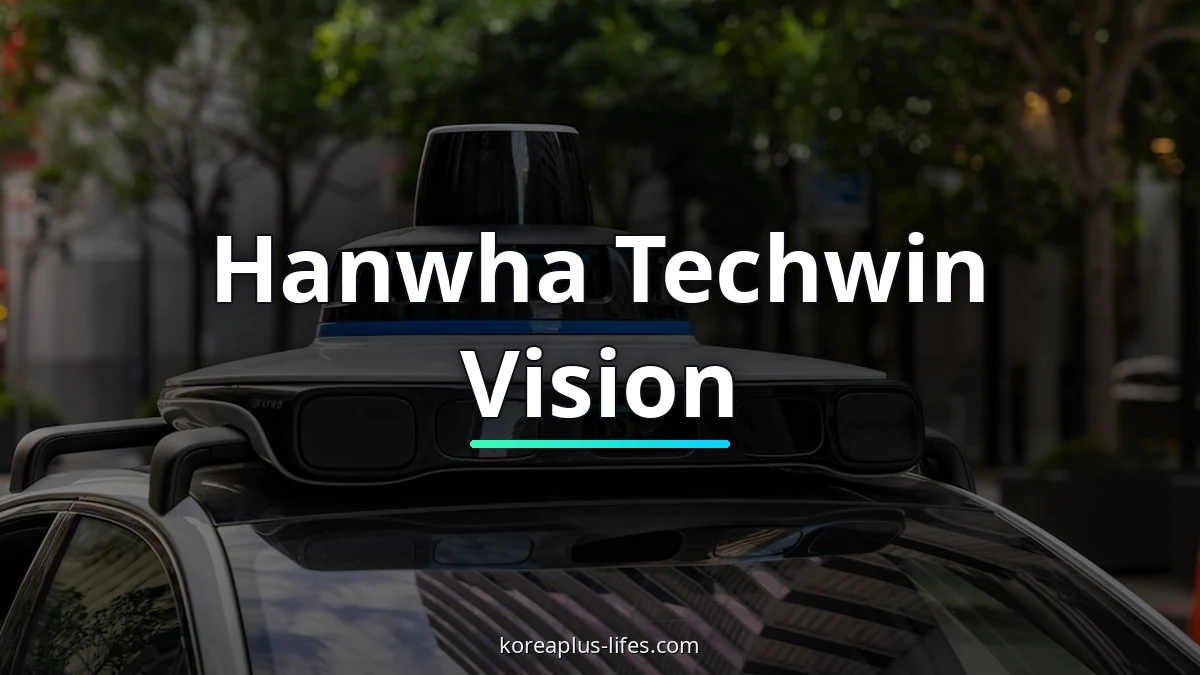
Beyond Hanwha Vision, other Korean companies contribute significantly to this advanced infrastructure. Solid Inc., for instance, specializes in intelligent in-building and outdoor wireless communication systems, crucial for ensuring the seamless data flow required by AI-powered surveillance networks. Their solutions provide the robust connectivity backbone that allows edge devices and central command centers to communicate without latency.
Even companies like LIG Nex1, primarily known for defense technologies, contribute to the broader ecosystem through their expertise in sensor fusion and advanced analytics that can be adapted for civilian urban applications. This cross-sector collaboration and shared technological heritage create a fertile ground for innovation in Korean smart city technology. These collective efforts demonstrate a nuanced understanding of urban demands, moving beyond simple camera installations to truly intelligent, responsive systems.
The strength of this ecosystem lies in its ability to provide end-to-end solutions, from hardware and software to network infrastructure and data management. But even with such advanced capabilities, global adoption faces significant hurdles.
Q4. What Are the Biggest Obstacles Blocking Global Adoption of Korean AI Surveillance?
Despite their technological lead and ethical design principles, Korean AI urban security solutions face considerable obstacles in achieving widespread global adoption. The primary challenge lies in the fragmented and often contradictory regulatory landscapes governing data privacy and AI ethics across different nations. What is permissible in a highly digitized society like South Korea may encounter significant pushback in European countries with strict GDPR regulations or in American cities wary of government overreach.
Public perception and trust also represent a major hurdle. Even with anonymization and edge processing, the very concept of AI-powered surveillance can trigger privacy concerns among citizens who are unfamiliar with the nuances of these technologies. Overcoming this skepticism requires extensive public education and transparent implementation, a process that is slow and resource-intensive for any company expanding internationally.
Furthermore, integrating new, advanced Korean smart city technology with existing, often decades-old legacy infrastructure in Western cities can be complex and costly. Municipalities are often constrained by budget cycles and entrenched procurement processes, making it difficult to rapidly adopt entirely new platforms. These factors mean that even with superior technology, the path to global market dominance is far from straightforward. So, what specific events could accelerate this change?
Q5. When Will Hanwha Techwin’s Integrated AI Solutions Achieve Wider Global Benchmarking?
The broader adoption of Hanwha Techwin’s (Hanwha Vision’s) integrated AI solutions on a global scale hinges on several key catalysts expected within the next 18-24 months. Firstly, a significant driver will be the emergence of more standardized international frameworks for AI governance and privacy, similar to the EU’s AI Act or updated versions of GDPR. If these frameworks begin to converge, Korean companies, already operating under robust domestic regulations, will find it easier to adapt their solutions for new markets.

Secondly, successful high-profile pilot programs in major non-Asian urban centers could serve as critical proofs of concept. If a city in North America or Europe publicly demonstrates measurable improvements in safety and efficiency using Korean AI-powered surveillance South Korea smart cities technology, while effectively addressing privacy concerns, it could create a powerful domino effect. Analysts expect that a major European capital could announce a significant deployment by late 2027 if current discussions materialize, signaling a shift in perception.
Finally, continuous technological advancements in edge computing and federated learning will further enhance the privacy-preserving capabilities of these systems, making them more palatable to skeptical populations. As the USD/KRW exchange rate fluctuates around 1533.44, it also presents a dynamic export environment. If global privacy standards converge towards GDPR-like frameworks, Korean solutions could see accelerated adoption by late 2027. This breaks if major data breaches or ethical missteps occur with early deployments, reinforcing public distrust.
📚 Sources & Further Reading
- AI Video Analytics for Smart Cities Market worth $28.76 billion by 2030 – Exclusive Report by MarketsandMarkets™ — PRNewswire
- Avnet Brings Ecosystem Together to Scale Edge AI in Singapore — BusinessLine
- Smart Home Market Expected to Reach US$ 1,434.47 Billion by 2034 — GlobeNewswire
- Wikipedia: Hanwha Techwin
🔗 Keep Reading
Written by Dokyung · KoreaPlus-Lifes
Dokyung is a Seoul-based industry watcher covering Korean semiconductors, batteries, AI infrastructure, and defense — and the companies behind them. Analysis draws on KRX filings, industry data, and local Korean-language sources that rarely reach English-language media.

Hi, I’m Dokyung, a Seoul-based tech and economy enthusiast. South Korea is at the forefront of global innovation—from cutting-edge semiconductors to next-gen defense technology. My mission is to translate these complex industry shifts into clear, actionable insights and everyday magic for global readers and investors.