

Tasted Real Shin Ramyun? Why the Gumi Ramen Festival Will Ruin Store-Bought Noodles for You
Check the expiration date on the instant noodles in your pantry. Six months left? A year? You assume dried noodles taste the same regardless of when they were made. You are wrong.
There is a secret word circulating among Korean foodies: “God-Twing-Yeon” (갓 튀긴 라면). It translates to “freshly fried ramen,” and it is a flavor profile that doesn’t exist in Seoul, Tokyo, or New York. It only exists in one specific industrial city in South Korea.
Welcome to Gumi, the birthplace of your late-night snack cravings. Here is why thousands of people are traveling to a factory town just to eat a bowl of instant noodles—and why you need to join them.
The “Factory-to-Table” Revolution

Usually, “Farm-to-Table” implies fresh vegetables. In Gumi, we have “Factory-to-Table.”
Gumi is home to the largest Nongshim manufacturing plant in the country. This factory produces more than 70% of the Shin Ramyun sold in Korea.
During the Gumi Ramen Festival, the noodles served aren’t from a dusty warehouse. They are brought straight from the production line.
The Texture: Noodles fried less than a week ago have a higher moisture content and elasticity.
The Smell: The oil is fresher, lacking the stale oxidation of exported packets.
The Verdict: It’s like drinking Guinness in Dublin or eating Pizza in Naples. It’s the “Source Code” of K-Food.
Beyond the Bowl: The “Noodle Road” Experience
The festival transforms the area around Gumi Station into a cyberpunk-meets-street-food haven. But don’t expect just plain boiling water. The creators here are rewriting the rules of instant food.
1. The Alchemist Chefs
Local restaurant owners compete to turn a 50-cent ingredient into a $10 dish.
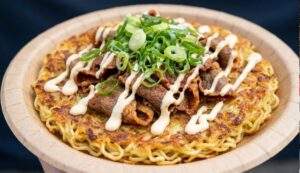
Must-Try: Chadol-bakgi Ramyun (Beef Brisket Noodles) where the beef fat emulsifies with the spicy powder to create a creamy, rich broth that rivals authentic Japanese Tonkotsu.
The Fusion: Ramyun Tacos and Noodle Jeon (Pancakes). It sounds strange, but the crunch of the uncooked noodle paired with salsa is a texture bomb.
2. The “Ramyun Library” on Steroids
Seoul has noodle libraries, but Gumi has the Noodle Tunnel. It is not just about variety; it represents the history of Korean industrialization. Walking through it, you realize that this simple brick of dried noodles fueled the nation’s economic growth. It is edible history.
The “God-Twing-Yeon” Zone (The Main Event)
This is the VIP section of the festival. This zone exclusively serves the “Freshly Fried” batches.
Insider Tip: Do not add eggs or cheese here. To appreciate the “0-Mile” difference, eat your first bowl completely plain. Focus on the chewiness of the noodle strands. You will notice they don’t get soggy as quickly as the ones you buy at Walmart.
Visual Guide: Comparison of Bubbles | Standard Ramen | “God-Twing-Yeon” (Fresh) Foams slightly due to oxidized starch | Clear, violent boiling bubbles | | Smell is purely spicy | Smell has a distinct savory, nutty undertone |
How to Execute This “Pilgrimage”
Gumi is not a typical tourist stop, which makes it perfect for travelers seeking the “Unfiltered Korea.”
The Timing: Usually late Autumn (Oct/Nov). The temperature drops, making the steam from the booths look cinematic.
The Transport: Take the KTX to Gumi Station. The festival begins the moment you step out of the exit. The air literally smells like spicy beef broth.
Where to Stay: Skip the big hotels. Look for local guesthouses near Geumosan Mountain. Start your morning with a hike, end it with noodles.

Conclusion: It’s Not Just About Calories
Why fly halfway across the world for instant food? Because in a world of standardized, mass-produced flavors, finding a version of the familiar that tastes wildly better is a rare thrill.
The Gumi Ramen Festival isn’t just a food event; it’s a pilgrimage to the source. It turns a lonely convenience store meal into a communal celebration.
So, pack your chopsticks. The freshest noodles of your life are waiting in a Korean factory town you’ve never heard of.
FAQ: The Nitty-Gritty
Q: Can I buy “Fresh Noodles” to take home?
A: You can buy the packets, but the magic of “God-Twing-Yeon” fades within weeks. It is an experience you must consume on-site. This scarcity is what makes the trip worth it.
Q: Is it English-friendly?
A: Gumi is less international than Seoul. However, the festival uses a “Kiosk” system with pictures. Plus, the word “Ramyun” is universal. Just point and slurp.
Q: What else is near Gumi?
A: Gumi is close to Daegu (famous for Makchang/grilled intestines) and Gyeongju (ancient history). It fits perfectly into a “Gourmet & History” itinerary of southeastern Korea.


Hi, I’m [jeybee]. As a long-time resident of Seoul, I’m passionate about uncovering the authentic, everyday magic of Korea. This blog is my way of sharing my favorite spots, tips, and cultural insights with you, beyond the usual tourist traps.