Busan is long, thin and hilly, so where you sleep decides how much of your day you spend on trains. Locals don't rank neighbourhoods by prettiness — we pick by metro line. Here's how the six areas visitors actually choose between really differ, including the honest downside of each.

First, the rule locals use: which line are you on?
Busan is a long ribbon of coast wedged against mountains, so the metro decides everything. Line 1 runs the old spine — Busan Station, Jungang, Nampo, Jagalchi — north to Seomyeon. Line 2 runs the coast: Seomyeon, Gwangan, Centum, Haeundae. They cross at exactly one point, Seomyeon. Work out which line your days sit on, then sleep on it.
There is a third rail we use and visitors miss: the Donghae Line (동해선), a KORAIL commuter train from Bujeon — about fifteen minutes' walk from Seomyeon — out through Centum, Sinhaeundae, Songjeong, Osiria and Gijang. It is the fastest way east and almost never crowded. Transfers between metro, bus and Donghae Line share one card.
- Line 1: Busan Station, Jungang, Nampo, Jagalchi, Seomyeon — old Busan, markets, the port.
- Line 2: Seomyeon, Gwangan, Centum City, Dongbaek, Haeundae — the coast and the beaches.
- Line 3: Suyeong to Yeonsan — mostly a shortcut between Lines 1 and 2.
- Donghae Line (KORAIL): Bujeon to Centum, Songjeong, Osiria, Gijang — the quiet east.
- Gimhae Airport: light rail to Sasang, then one Line 2 ride through Seomyeon to Haeundae.
Haeundae: one name, two very different stays
Haeundae-gu (해운대구) splits in two. The beach strip behind Gunam-ro is walk-out-and-swim territory: Haeundae Market, Dongbaekseom's coastal trail, the Blueline Park beach train from Mipo. This is the easy, obvious, priciest choice, and for first-timers and families with small kids it genuinely earns it — everything is on foot, in English, and open late.
Marine City (마린시티), ten minutes west near Dongbaek Station, is the skyscraper half: quieter streets, restaurants aimed at residents, Gwangan Bridge glowing across the water. Downside for both — Haeundae is generally the most expensive bed in the city, it is close to an hour by metro from Nampo, and in August the strip is packed shoulder to shoulder.
Gwangalli and Seomyeon: the two smartest defaults
Gwangalli (광안리) is where I send most people. Gwangan Station on Line 2, five to thirteen minutes' walk depending on the exit, and a beachfront of cafés and small bars facing the bridge. It skews younger and rooms generally cost less than an equivalent Haeundae one. Downside: fewer big-brand hotels, thinner sand, and Saturday drone-show crowds.
Seomyeon (서면) is the real city centre — Lines 1 and 2 cross here, so nothing in Busan is more than one change away. It has the densest eating and shopping in the city and rooms are usually the best value going. Downside, and it is a real one: no sea, no view, and a loud late-night street scene.
Old Busan: Nampo-dong, Jagalchi and Busan Station
Nampo-dong (남포동) is the Busan that existed before the towers: Jagalchi, Gukje Market, BIFF Square, Yongdusan and the working harbour, all on Line 1 within a few hundred metres. For a two- or three-night first visit it is the most walkable base in the city. Downside: the sea here is port, not swimming, and evenings quieten early.
Two stops north, Busan Station (부산역) and Choryang (초량) are pure logistics: KTX from Seoul in about two and a quarter hours at best, the Japan ferry terminal a ten-minute walk, Chinatown and Choryang's Ibagu-gil hill lanes at the door. Stay here for arrive-late, leave-early nights. Downside: the streets around the station are tired rather than scenic.
Songjeong and Gijang: save these for your second trip
Songjeong (송정) is a small, round bay twenty-odd minutes east of Haeundae — surf schools, board racks on the sand, a beach that stays usable when Haeundae is a wall of parasols. Beyond it, Gijang (기장) spreads into the Osiria complex: theme park, outlet malls, cliff-edge cafés and quiet coastal temples.
Both sit on the Donghae Line, so Seomyeon is a single train away and Haeundae a short bus. Honest downside: this is a classic first-visit mistake. Dinner options thin out after 9pm, you will taxi more than you expect, and everything in central Busan becomes a 40–60 minute commitment rather than a whim.
Why a sea-view room is worth less than it costs in winter
Ocean-view rooms carry a hefty premium, and from December to February you are paying for a window you will not open. January is Busan's coldest and windiest month — highs near 6°C, lows around freezing, the wind off the water constant. Sunset falls in the late afternoon, so most of your view is a dark bay and hotel lights.
Summer is not automatic either: sea fog, haemu (해무), is commonest in July and can erase Gwangan Bridge for days. My rule — take the cheaper city-view room, put the difference into a bridge-facing café seat or the Dongbaekseom trail, and you will see more of Busan than any window shows.
📍 The exact spots
Haeundae Beach Strip
The default first-timer base. Line 2 to Haeundae Station, then everything on foot: 1.5km of sand, Gunam-ro's restaurant grid, Haeundae Market, the Dongbaekseom trail and the Blueline Park beach train at Mipo.
💡 Book a Jung-dong or Mipo end address, not mid-beach — quieter at night, same sand, and you walk straight onto the beach train at Mipo.
Marine City, Haeundae
Haeundae's high-rise half, near Dongbaek Station on Line 2. Bridge views across the water, restaurants that serve residents rather than tour groups, and The Bay 101 and Dongbaekseom's coastal path within a walk.
💡 Dongbaek Station Exit 1, then the Dongbaekseom loop after dark — the bridge and Marine City skyline line up better here than from Haeundae's sand.
Gwangalli

Bridge-view beachfront on Line 2, cheaper than Haeundae for a comparable room. Gwangan Station Exit 3 or 5, then 5–13 minutes downhill to cafés, small bars and a young crowd. Suyeong Station next door adds Line 3.
💡 The free M Drone Light Show runs Saturday nights year-round; check the official site that afternoon, as wind and rain cancel it.
Seomyeon
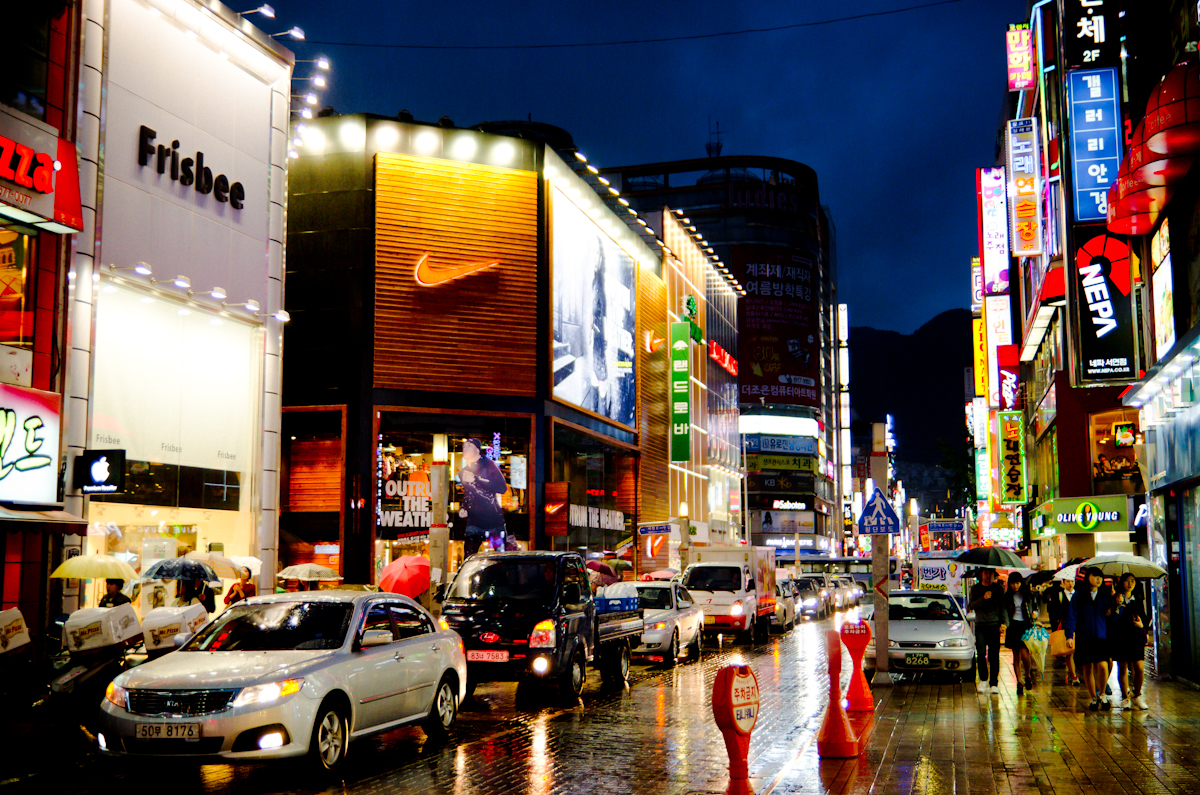
The true centre, where Lines 1 and 2 cross — the only interchange between old Busan and the coast. Densest eating and shopping, department stores, best-value rooms, and Bujeon Station for the Donghae Line 15 minutes' walk away.
💡 Sleep a block or two off Seomyeon 1-beonga's bar strip — same five-minute walk to the station, several fewer hours of noise.
Nampo-dong and Jagalchi

Old Busan on foot: Jagalchi, Gukje Market, BIFF Square, Yongdusan Park and the harbour, all inside a few Line 1 stops. Best base for a short first visit and for anyone chasing the city's film history.
💡 Stay near Jungang rather than Jagalchi if you have an early train — one stop from Busan Station and far quieter after the markets shut.
Busan Station and Choryang

Pure convenience. KTX from Seoul in roughly two and a quarter hours, the Japan ferry terminal a short walk behind, Chinatown opposite, and Choryang's Ibagu-gil hillside lanes climbing straight up from the platform.
💡 The 168 Stairs monorail is gone; a free inclined elevator replaced it in March 2025. Check Dong-gu's page for current hours before climbing.
Songjeong and Gijang

The repeat visitor's choice. A small surf bay with board rental and lessons, then Gijang's Osiria complex — theme park, outlets, cliff cafés — all strung along the Donghae Line and the Blueline Park beach train.
💡 Surf lessons typically run ₩50,000–65,000 and board rental from about ₩15,000–20,000; go on a weekday morning for space and cheaper slots.
💡 Quick honey tips (꿀팁)
- Pick your area by metro line first, view second. Line 1 is old Busan; Line 2 is the coast; they meet only at Seomyeon.
- Buy a rechargeable transport card at any convenience store — it covers metro, buses and the Donghae Line with transfer discounts.
- Last metro trains leave roughly 23:30–midnight. If you plan late nights out, sleep in Seomyeon or Gwangalli, not Gijang.
- Haeundae's Badamaeul pojangmacha village was demolished in June 2024 — don't book a hotel expecting that tent-bar scene.
- Millak Waterside Park has been alcohol-free since July 2023, with a ₩50,000 fine. Drink on a terrace, not the deck.
- Flying into Gimhae? Line 2 areas — Seomyeon, Gwangalli, Haeundae — need only one change, at Sasang.
- Hills matter here. Check whether your address sits above the station; a 300m walk in Choryang can be four flights of stairs.
- August and early October (film festival) are the two stretches when Busan actually sells out. Book those far ahead.
FAQ
Where should a first-time visitor stay in Busan?
Haeundae if you want the beach-resort version and don't mind paying most; Gwangalli if you want the same coast, bridge views and better value; Nampo-dong if your trip is two or three nights and mostly markets, port and old streets. All three are easy without Korean.
Is Seomyeon worth staying in with no sea view?
For most trips, yes. It is the only place where Lines 1 and 2 meet, so both halves of Busan are one change away, the eating is the city's best and rooms cost less. Choose it if you are here to eat, shop and move fast rather than sit on sand.
Which area suits families with young children?
Haeundae's beach strip. You can be on sand within a minute of the lobby, the Blueline Park beach train from Mipo entertains kids for an hour, Haeundae Market handles fussy eaters, and pharmacies and convenience stores are everywhere. It costs the most, and with small children that trade is usually worth it.
I'm here for the film festival — where do I stay?
Main BIFF screenings sit in Haeundae-gu, at the Busan Cinema Center and the Centum City multiplexes, so stay in Haeundae, Centum or Gwangalli. Nampo-dong's BIFF Square is the festival's birthplace and hosts Community BIFF events, but it is a long ride from the main venues. Book early — October fills.
Where should I sleep if I arrive late or leave early?
Busan Station or Choryang. The KTX platform, the Japan ferry terminal and Chinatown are all within about ten minutes on foot, and Line 1 reaches Nampo in minutes. Accept that the immediate streets are workmanlike rather than pretty.
Is a sea-view room worth the extra?
In summer, sometimes. In winter, rarely — January is the coldest, windiest month, the balcony stays shut and it is dark by late afternoon. July brings sea fog that can hide Gwangan Bridge entirely. Take the cheaper room and spend the difference on a bridge-facing café or a night walk.
Is Songjeong too far for a first trip?
Usually, yes. It is lovely — small bay, real surf, room to breathe — but you will spend 40 to 60 minutes each way reaching central Busan, and dinner options thin after 9pm. Save it for a second visit, or for a couple of nights at the end of a Haeundae stay.