Busan runs on its markets. Ajummas who have gutted mackerel for forty years, hotteok griddles that never cool, alleys that fed war refugees and now feed everyone. Forget the department stores — this is where the city actually eats. Here's how to shop, order, and haggle like you grew up three stops down Line 1.

Market culture 101: cash, ajummas, and closed days
Busan markets run on cash and relationships. Vendors take cards more than they used to, but the ₩3,000 snack economy is still cash-first — carry ₩10,000 notes and coins and nobody sighs at you. The women running the stalls are ajumma, and many have held the same corner for decades; a little warmth — 'annyeonghaseyo', a nod, eating what you're handed — buys better service than any phrasebook.
One thing visitors always miss: traditional markets keep monthly rest days, usually a fixed Tuesday or Sunday pattern rather than a weekly closure. Jagalchi's main building, for example, traditionally rests on the first and third Tuesday. Always check before making a market the anchor of your day — a shuttered arcade is a sad breakfast.
Jagalchi: haggle downstairs, feast upstairs
Jagalchi is Korea's biggest seafood market, and it works on a beautiful system: buy your fish downstairs, then carry it to the second-floor restaurants where they cut, grill, or boil it for a table fee called sangcharimbi. The fee covers rice, side dishes, and the work — it's standard, not a tourist trap. Point at what's swimming, agree on a price, and lunch is minutes old.
Haggling is expected on whole fish and bulk shellfish, not on set portions. Ask 'eolmayeyo?' (how much?), look mildly thoughtful, and a vendor will often round down or throw in extras — a handful of clams, an extra crab leg. Pushing past ten percent off is bad form. If an ajumma waves you to her tank, let her talk; the show is half the meal.
Gukje Market: born from war, run on noodles
Gukje Market was born in the churn of 1945, when Japan’s defeat left a city full of goods and no owners and traders called it the Dotteqi Market. Korean War refugees then doubled Busan’s population and turned the improvised stalls into the sprawl you walk today. That survivor DNA is still in the layout: a dense grid of alleys, each specializing — fabrics here, kitchenware there, food woven through all of it. It's the market from the film 'Ode to My Father', and it earned the fame.
Head for the food alleys, where ajummas ladle yubu-jeongol — a gentle hot pot of stuffed fried-tofu pockets — and mix bibim-dangmyeon, chewy glass noodles tossed in sweet-spicy sauce that barely exists outside Busan. Sit on the low stools, order both, and split them. Most bowls land well under ₩10,000, and the ladies top up broth without being asked.
After dark: Bupyeong Kkangtong Night Market
When Gukje's shutters come down, walk a few blocks to Bupyeong Kkangtong Market. The 'tin can' name dates to the postwar years, when American canned goods — often straight off the bases — were the hot commodity. In 2013 it became Korea's first official night market, and now carts roll out around 7:30pm selling everything from Busan eomuk to Vietnamese spring rolls.
The night-market strategy: go hungry, buy small, keep moving — portions are snack-sized on purpose. Nearby, the jokbal alley serves Busan's signature naengchae-jokbal, cold braised pork trotters with jellyfish and mustard sauce, which sounds alarming and tastes like a revelation. Cash is king here after dark.
Haeundae Traditional Market: the post-beach ritual
Haeundae Traditional Market sits one block behind the beach, and the post-swim routine is sacred: hot eomuk broth in a paper cup, a hotteok for the walk, then — if you're committed — gomjangeo, the charcoal-grilled hagfish this market is famous for. It's louder and saltier than the polished beachfront, which is exactly the point. In peak season, go before noon.
The eating list: don't leave without these
Busan street food has its own canon. Some of it began as refugee survival food, some as beach-town snacking; all of it is cheap, fast, and best eaten standing up.
- Ssiat hotteok (씨앗호떡) — brown-sugar pancake split and stuffed with seeds; born at BIFF Square
- Bibim-dangmyeon (비빔당면) — Gukje Market's chewy glass-noodle classic in sweet-spicy sauce
- Yubu-jeongol (유부전골) — stuffed fried-tofu-pocket hot pot from the Gukje food alleys
- Busan eomuk (어묵) — fish cake on a stick; the broth cup is part of the deal
- Milmyeon (밀면) — wheat-flour cold noodles, Busan's refugee-era answer to naengmyeon
- Naengchae-jokbal (냉채족발) — cold pork trotters with jellyfish and mustard dressing, Bupyeong style
- Gomjangeo (곰장어) — charcoal-grilled hagfish, the Haeundae market specialty
📍 The exact spots
Jagalchi Market
Korea's largest seafood market, run largely by veteran ajumma vendors. Tanks of live fish downstairs, restaurants upstairs that cook your purchase on the spot. Loud, wet, and gloriously alive since the postwar years.
💡 Go around 10am on a weekday: morning chaos over, tanks full, upstairs tables empty. Budget for the sangcharimbi table fee — it's standard.
Gukje Market
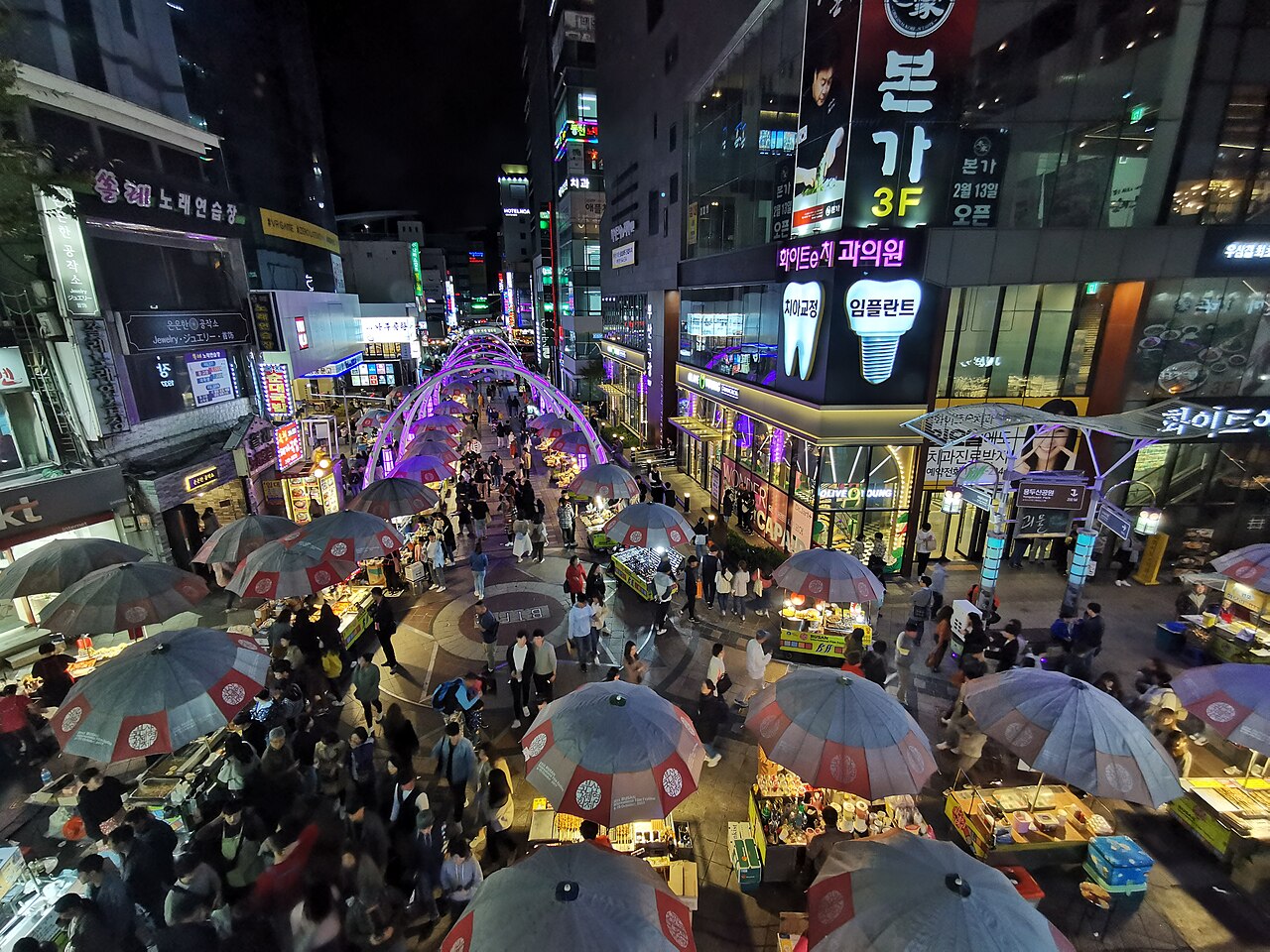
A sprawling grid of alleys that began in 1945 and exploded with Korean War refugees, now selling everything from vintage clothes to kitchen knives — with legendary food lanes serving yubu-jeongol and bibim-dangmyeon in between.
💡 The food alleys get slammed at lunch; arrive by 11:30am or after 2pm. Order bibim-dangmyeon and yubu-jeongol together — vendors expect the combo.
BIFF Square
The old film-festival plaza in Nampo-dong, now better known for its hotteok stalls. This is the birthplace of ssiat hotteok — the seed-stuffed version that became Busan's most copied street snack.
💡 Queues look scary but move fast. Take the paper cup and gloves offered — molten brown sugar burns are a Busan rite of passage.
Bupyeong Kkangtong Night Market

Korea's first official night market, in an arcade whose 'tin can' nickname comes from postwar trade in American canned goods. From about 7:30pm, carts serve Korean classics beside international street food.
💡 Portions are small by design — bring a friend, buy one of everything, and carry cash. Weeknights are far calmer than Friday and Saturday.
Bupyeong Jokbal Alley
A strip of decades-old restaurants beside Bupyeong Market that made naengchae-jokbal — cold braised pork trotters with jellyfish and mustard dressing — a Busan signature dish.
💡 Order the half-and-half plate: warm jokbal plus cold naengchae on one platter. A medium plate feeds two with drinks.
Haeundae Traditional Market
A covered market lane one block from Haeundae Beach — eomuk stands, hotteok griddles, fruit stalls, and the charcoal-grilled gomjangeo (hagfish) restaurants that stay busy long after the beach empties.
💡 Hit it wet-haired straight off the beach like locals do. The eomuk broth is free with your fish cake — hold the cup with both hands.
💡 Quick honey tips (꿀팁)
- Carry small bills; breaking a ₩50,000 note at a ₩3,000 stall earns you a legendary ajumma glare.
- Weekday mornings from 10am to noon are the sweet spot: full stalls, no crowds. Saturday afternoons in Nampo-dong are shoulder-to-shoulder.
- Learn three phrases: annyeonghaseyo (hello), eolmayeyo (how much?), jal meokgesseumnida (I'll eat well). Doors open.
- Jagalchi, Gukje Market, and BIFF Square are a ten-minute walk apart — do all three as one food crawl.
- Check monthly closed days before anchoring your itinerary to one market; a fixed Tuesday or Sunday pattern is common.
- At night markets, split everything. Two people sharing five snacks beats two people finishing two.
- The broth at eomuk stalls is self-serve and free — refill politely, don't camp on it.
FAQ
Can I pay by card at Busan markets?
Bigger stalls and sit-down restaurants usually take cards, but small snack vendors are cash-first. Carry ₩30,000–50,000 in small notes per person for a market day. ATMs cluster near main entrances, though foreign cards tend to work best at convenience-store ATMs nearby.
How does haggling work at Jagalchi if I don't speak Korean?
Point, smile, and use your phone calculator — vendors will type a price and you can counter. Haggling applies to whole fish and bulk shellfish, not cooked food. Aim for a small discount or free extras rather than a dramatic cut; it's a relationship, not a battle.
What is the table fee at Jagalchi's upstairs restaurants?
It's called sangcharimbi — a per-person charge covering cooking, rice, and side dishes when you bring up fish bought downstairs. It's standard practice, not a scam. Confirm the fee before sitting down, and expect it to be quoted per person, not per table.
What days are Busan markets closed?
Most traditional markets rest one or two fixed days a month — commonly specific Tuesdays or Sundays — rather than closing weekly. Jagalchi's main building traditionally closes the first and third Tuesday. Night markets run daily, but individual stalls take their own days off, so check official pages first.
Is Busan street food safe to eat?
Generally very safe — turnover is fast and everything is cooked in front of you. Stick to busy stalls with lines of locals, eat things served hot, and you'll be fine. Follow the crowd of uniformed school kids; they have the best radar in the city.