Busan has been a UNESCO City of Film since 2014, and every autumn the city fills up with lanyards and queues. But you don't need a festival pass to feel it. Here's how BIFF really works for a visitor, plus the corners of Busan where Korea's best-known films were actually shot.

What BIFF actually is — and when it lands
BIFF (부산국제영화제) started in 1996 and grew into Asia's biggest film festival. Its base is the Busan Cinema Center (영화의전당) in Centum City, with extra screens at CGV and Lotte Cinema next door. The 31st edition runs 6–15 October 2026, but the dates shift — the 30th ran in mid-September 2025. Check biff.kr before you book flights.
For ten days the city genuinely changes. Centum City fills with lanyards, Haeundae hotels sell out, and the Nampo-dong end of town runs its own community programme. Even if you never sit down in a cinema, the festival spills outdoors — red carpets, open-air screenings, and a lot of people arguing about films on the pavement.
Tickets, the realistic version
Tickets go on sale online at ticket.biff.kr a couple of weeks before opening night, in staggered batches: ceremonies and galas first, general screenings a day or two later, each at a set hour. Anything with a famous director or a guest talk disappears within minutes. A regular screening cost ₩10,000 in 2025; galas cost far more.
- Register on ticket.biff.kr and log in before the sale opens — the rush starts at the exact posted minute.
- Two tickets per film per transaction is the usual cap.
- On-site BIFF Ticket Boxes sell only what did not sell out online, so arrive when they open.
- Cancellations release seats continuously; refresh in the days before your screening.
- Anything with a director Q&A goes fastest — line up a second choice in the same time slot.
The free part: the Cinema Center's roof
The Busan Cinema Center's Big Roof is the world's longest cantilever roof, and its underside is one enormous LED canvas. After dark it plays motion graphics over Dureraum Square — free, no ticket, no queue. Locals treat it as a place to sit rather than a show: students on the steps, families on the plaza, the whole structure lit like a spaceship.
Show times move with the season, so check dureraum.org rather than a blog post. It pairs neatly with a Gwangalli evening — the drone show and the roof are about twenty minutes apart on Line 2, and our Busan after dark guide sequences them properly.
BIFF Square: where the whole thing began
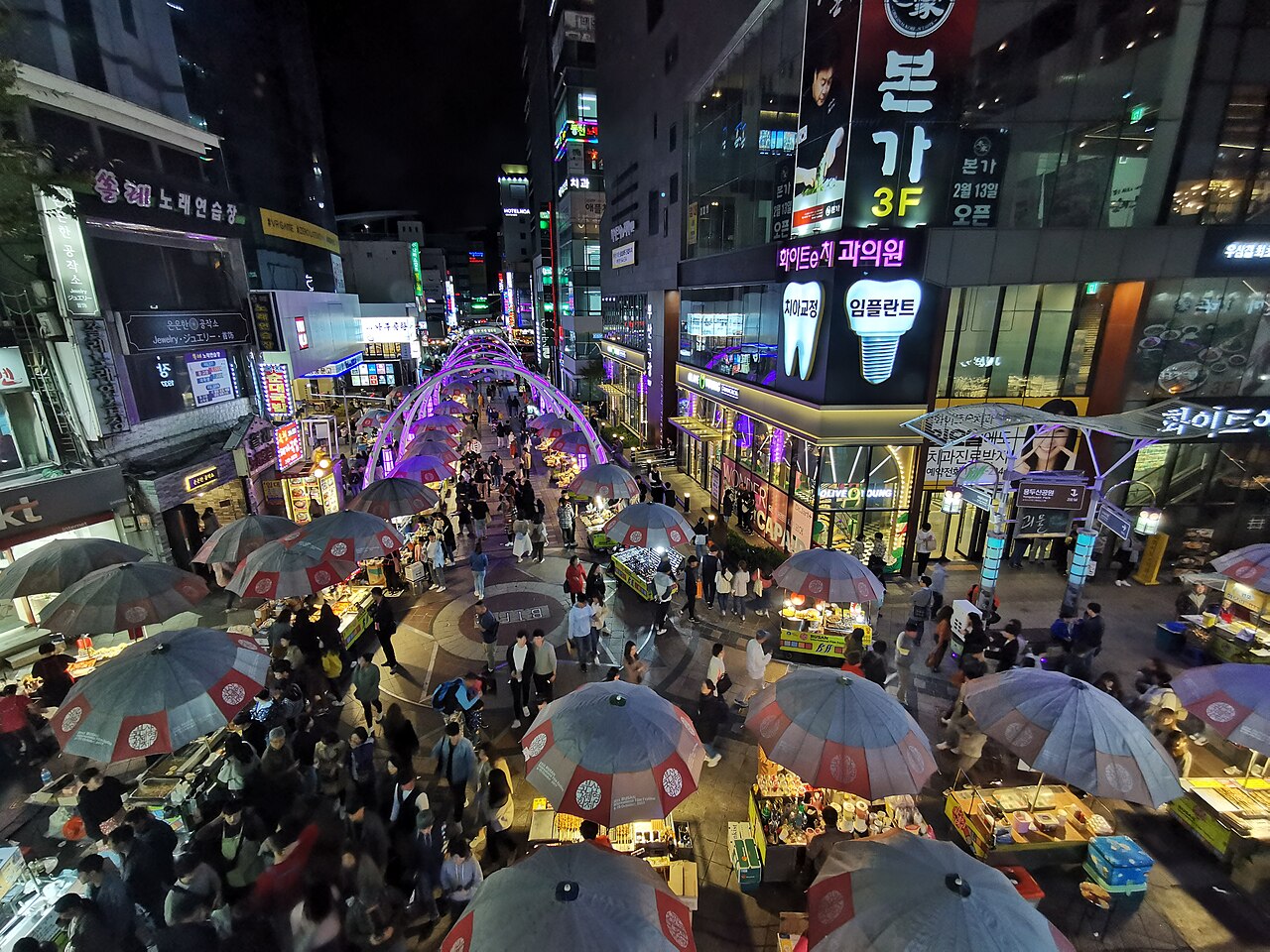
Before Centum City there was a strip of cinemas in Nampo-dong. The city renamed it BIFF Square (BIFF광장) in 1996 for the first festival, and the 428-metre street still splits into Star Street and Festival Street. Set into the pavement are bronze handprints laid at the pre-festival ground-opening ceremony — Ennio Morricone, Juliette Binoche, Willem Dafoe, Korean directors going back decades.
Most visitors come for the hotteok and miss the handprints entirely, because they are underfoot rather than on a wall. Our markets and street food guide handles the eating side of this street; here, just remember to look down as you walk.
Film city the other fifty weeks
Busan became Asia's first UNESCO Creative City of Film in December 2014, and the Busan Film Commission — running since 1999 — is why so many Korean productions shoot here: permits, crews and a large indoor studio by Suyeong Bay in one city. That studio is a working facility, not a theme park, so contact the commission ahead if you hope to see inside.
For a rainy afternoon, the Busan Museum of Movies (부산영화체험박물관) near Yongdusan is hands-on and refreshingly unpretentious. And the Cinema Center's 212-seat Cinematheque runs retrospectives all year — the cheapest way to watch a film in Busan the way locals do.
Location-hunting without being a nuisance
Almost every famous Busan location is somewhere people live. Huinnyeoul (흰여울문화마을) is a lane of front doors a metre from the path. Gamcheon (감천문화마을) has quiet-please signs in two languages and marked no-photo spots. These village lanes are not a set, and residents have painted over murals before when visitors pushed too far.
So: voices down, nothing shot into windows or laundry, no drones, and finish before dinnertime. Both villages appear in our hidden neighbourhoods guide with walking routes — treat the film angle as an extra layer over that, not a licence.
📍 The exact spots
Busan Cinema Center
BIFF's home in Centum City: three buildings, a 212-seat cinematheque, and a 4,000-seat open-air BIFF Theater under a Guinness-record cantilever roof that becomes an LED screen after dark.
💡 Line 2 to Centum City, Exit 12, five minutes' walk. Arrive after sunset; show times shift by season, so check dureraum.org.
BIFF Square
The 428-metre Nampo-dong strip renamed for the festival in 1996. Star Street's pavement carries bronze handprints of directors and actors — Ennio Morricone, Juliette Binoche and Willem Dafoe among them.
💡 Handprints are underfoot, not on walls — look down. Come before 11am for photos without the hotteok queue crossing your frame.
Huinnyeoul Culture Village
Cliff-edge lanes on Yeongdo above Namhang Bay, used for The Attorney and Nameless Gangster. Jinu's House from The Attorney is now a small exhibition space with film lines painted on the wall.
💡 Walk the lower coastal path first and climb to the lanes second — the sea-level tunnel frame everyone wants is at the bottom.
Gukje Market — Kkotbunine
Ode to My Father was set in this post-war market, and Kkotbunine — the imported-goods shop run by the hero's family — still trades on its corner as a photo stop.
💡 It's a working shop, so buy something small before photographing. Ask a stallholder for 꽃분이네 by name if the alleys confuse you.
Gamcheon Culture Village

The stacked pastel hillside that camera crews and music-video directors keep returning to. Quiet-please notices and posted visiting hours run through the lanes, because these are people's homes, not a set.
💡 Skip the Little Prince selfie queue at midday; the same view is empty around 9am, and the far ridge lanes stay quiet all day.
Mipo Port, Haeundae

The working harbour at the eastern end of Haeundae Beach, where the 2009 disaster film Haeundae was shot. Boats, ice houses and tackle shops — nothing like the resort skyline behind it.
💡 Come at first light while the boats unload; it's also the start of the Blueline Park beach train, so pair the two.
Cheongsapo Twin Lighthouses
A fishing hamlet between Haeundae and Songjeong with red and white lighthouses on facing breakwaters — a familiar frame in Korean films and dramas, including the 2016 romance Mood of the Day.
💡 Walk out to the red lighthouse in late afternoon for backlit sea; the white one faces the village and shoots better at sunrise.
Busan Museum of Movies
A hands-on film museum near Yongdusan Park in Jung-gu — foley booths, animation desks, green screens. Genuinely useful on a wet Nampo-dong afternoon, about ten minutes on foot from BIFF Square.
💡 Closed Mondays and adult entry runs around ₩10,000 — confirm on the official site before crossing town, and allow ninety minutes.
💡 Quick honey tips (꿀팁)
- Book online the minute sales open; popular titles vanish in minutes, but cancellations reappear right up to screening time.
- Same-day tickets exist only for screenings that didn't sell out online — reach the BIFF Ticket Box early.
- Swap a mobile ticket for paper at a ticket box if your battery worries you; lost paper tickets aren't reissued.
- Centum City hotels sell out during BIFF; Gwangalli or Seomyeon plus Line 2 is cheaper and just as quick.
- Guest talks after screenings are often interpreted into English — sit near the front to hear the interpreter clearly.
- October evenings by the Suyeong River turn windy; bring a layer for the open-air BIFF Theater.
- Filming-location villages are homes: voices low, no shooting through windows, and obey every no-photo sign.
- Pair a Nampo-dong film walk with Bosu-dong Book Alley and Yongdusan — all within fifteen minutes on foot.
FAQ
When is the Busan International Film Festival held?
Usually early October — the 31st edition runs 6–15 October 2026 — but the dates genuinely move; the 2025 festival ran 17–26 September. The programme, venues and ticket dates are published on biff.kr a couple of months ahead, so confirm there before booking flights or hotels.
How do BIFF tickets work for a foreign visitor?
Online sales at ticket.biff.kr open in staggered batches ahead of the festival, with an English interface. Register and log in before the exact opening minute, because popular screenings sell out in minutes. Two tickets per film per transaction is standard. Whatever doesn't sell online is then offered at on-site BIFF Ticket Boxes.
Can I experience BIFF without a ticket?
Yes. Dureraum Square at the Cinema Center is open and free, the LED roof show costs nothing, and the outdoor plaza carries red-carpet crowds, pop-ups and photo walls through the festival. BIFF Square in Nampo-dong runs its own street programme at the same time.
Is the Busan Cinema Center worth visiting outside festival season?
Very much. The architecture alone justifies the trip, the free evening roof show runs year-round, and the 212-seat Cinematheque programmes retrospectives and arthouse titles all year. Check dureraum.org for the current schedule and lighting times, which vary by season.
Which Busan filming locations can I actually visit?
Gukje Market for Ode to My Father and the Kkotbunine shop; Huinnyeoul on Yeongdo for The Attorney and Nameless Gangster; Mipo Port for the disaster film Haeundae; Cheongsapo's twin lighthouses; and Gamcheon, a standing favourite of crews and music-video directors.
Can I tour the Busan Film Studio?
It is a working production facility near Suyeong Bay, not a visitor attraction. The Busan Film Commission has run limited viewing sessions, but availability changes — contact them in advance rather than turning up. For a walk-in film experience, the Busan Museum of Movies in Jung-gu is the reliable option.
What's the etiquette at residential filming spots?
Keep your voice down, stay on public paths, never shoot into windows or courtyards, and respect posted no-photo signs. Gamcheon and Huinnyeoul both have residents living metres from the viewpoints. Visiting in daylight hours and leaving by early evening is the local expectation.