Busan is one of Korea's kindest big cities to a wallet — the best things here are genuinely free and the best food is the cheapest. Here's what a real day costs at three honest levels, the metro math, and the markups we locals quietly walk past. All prices are typical ranges; check official pages for anything dated.
Three honest daily budgets
These are full-day figures — bed, three meals, transport, one paid activity — at typical 2026 prices, per person. Busan rewards the low end: an ₩8,000–10,000 gukbap (국밥) outclasses most ₩30,000 tourist dinners. Your pillow moves the number more than anything else, so the tiers differ mainly by where you sleep and one daily splurge.
- Backpacker, roughly ₩50,000–70,000: guesthouse dorm (₩20,000–35,000), gukbap and market meals, ₩2,000 franchise coffee, ₩6,000 metro day pass, free beaches and temples.
- Mid-range, roughly ₩90,000–140,000: clean motel or business hotel (₩50,000–80,000), one proper sit-down meal, a jjimjilbang session (₩10,000–15,000), transit plus one short taxi.
- Comfortable, roughly ₩180,000–300,000: 3–4-star hotel (₩120,000–200,000+, sea view extra), a hoe (회, raw fish) dinner, Spa Land at about ₩20,000, taxis whenever tired.
The free list is the good list
Busan's headline sights cost nothing: every beach, the Igidae (이기대) and Dalmaji coastal paths, Gamcheon's painted lanes, and — since Korea abolished temple admission fees in May 2023 — the grounds of Beomeosa (범어사) and 64 other Jogye temples. Saturdays add a free drone show over Gwangalli (광안리). Our beaches, night-views and temples guides map the details; a backpacker day can be built entirely from this list.
Transit math: pass, card or taxi
A card ride on the metro is about ₩1,600 (₩1,700 by paper ticket or QR), so the ₩6,000 one-day pass breaks even on ride four — normal for a sightseeing day — and a ₩13,000 three-day version exists. For three or four people hopping a couple of stops, one taxi from the ₩4,800 base fare often beats everyone tapping separately. Fares rose twice recently, so treat these as typical and check current prices.
Eat where the regulars eat
The cheap food here is the good food. Follow office workers at lunch to dwaeji-gukbap (돼지국밥) or milmyeon (밀면) counters, where ₩8,000–10,000 buys a full meal with refillable sides and free water. Markets stack the snacks — eomuk (어묵), ssiat hotteok (씨앗호떡), tteokbokki — at roughly ₩1,000–3,000 apiece. Our eat-like-a-local and markets guides name names; the budget rule is simple: no photo menus, no touts, follow the queue.
Sleep cheap by sleeping smart
Your bed sets the budget. The same comfort costs least around Seomyeon (서면) and Nampo (남포동) — dorms typically ₩20,000–35,000, decent motels ₩50,000–80,000 — and most beside the Haeundae sand, where a sea view can nearly double a room. Sleeping central and metro-ing to the beaches is the local-approved cheat; our where-to-stay guide breaks down each area's price logic, and Friday–Saturday nights spike everywhere.
Where tourists overspend — and locals don't
The classic leaks: ₩7,000 lattes bought for a sea view the sand gives you free; hotel breakfasts at ₩20,000-plus when the gukbap house next door charges ₩9,000; taxis at rush hour, when the meter ticks while you crawl; and raw-fish dinners ordered without agreeing prices first. None are scams — they're just the tourist path of least resistance.
And the happiest saving of all: tipping does not exist in Korea. Not in taxis, restaurants, cafés or hotels — prices are final, service is included, and leaving extra genuinely confuses people. Budget exactly what the menu says.
📍 The exact spots
Gukje Market
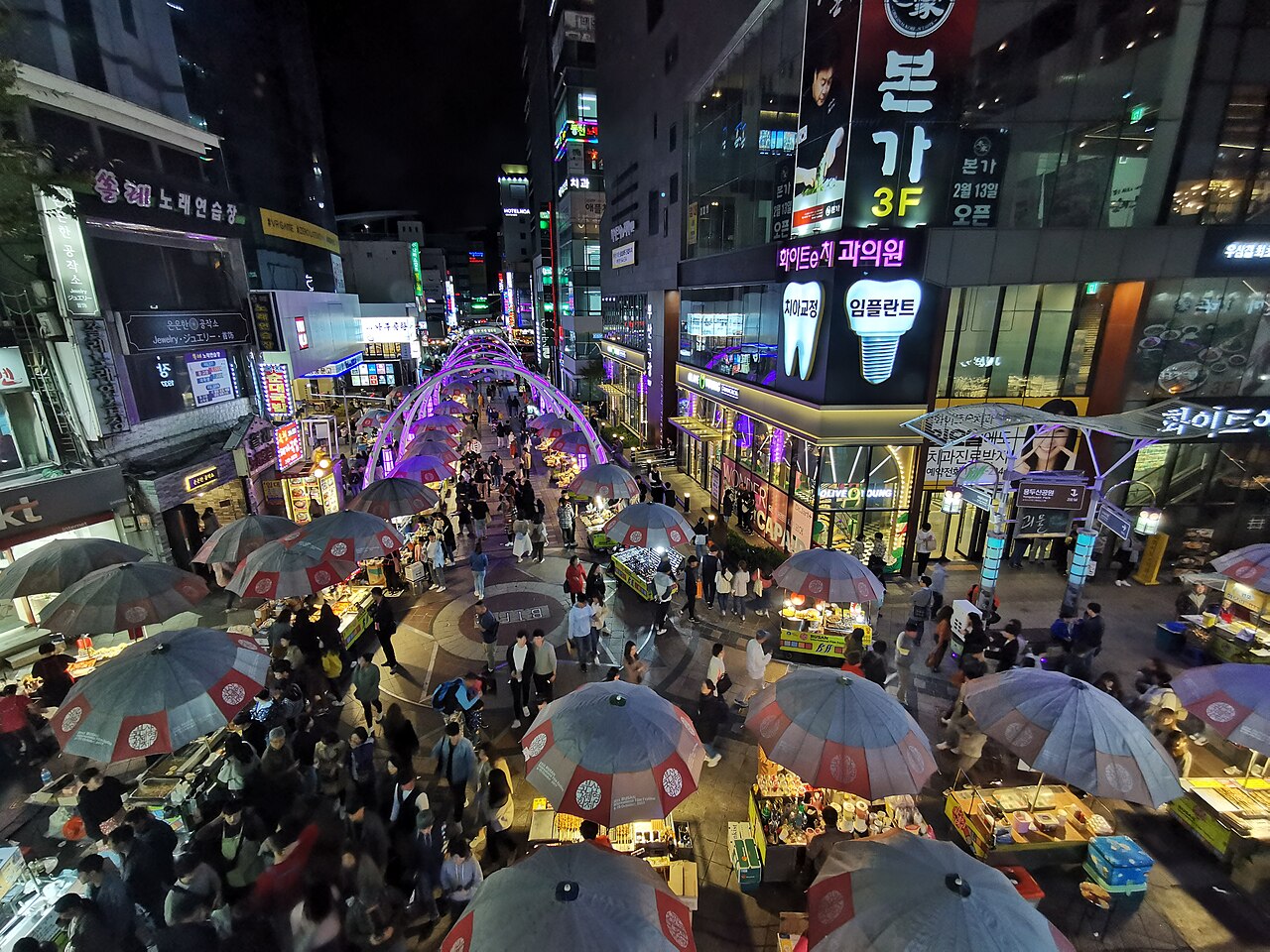
Nampo's post-war market sprawl is budget headquarters: clothes, homewares and food alleys where ₩10,000 is a feast. It blends straight into Bupyeong Kkangtong Market (부평깡통시장) and the street-food rows.
💡 Eat in the interior food alleys where the stallholders themselves lunch, not the outward tourist-facing rows — same dishes, calmer prices.
Jagalchi Market

Korea's largest fish market. Raw fish is the splurge; the budget move is a grilled-fish set meal or eomuk from the stalls ringing the building, around ₩10,000.
💡 Ordering hoe upstairs? Agree the all-in price — fish plus table-setting charge — before you sit down.
Gamcheon Culture Village

The painted hillside costs nothing to wander — the best free half-day in the city. The optional ₩2,000 stamp map funds village projects and ends in souvenir postcards.
💡 Take bus 2-2 from near Toseong Station uphill and walk down — spend energy, not money, in the lanes.
Beomeosa

Busan's grandest temple dropped its admission fee in May 2023, when Korea scrapped charges at 65 Jogye-order temples. A genuine mountain monastery, now completely free to enter.
💡 Metro to Beomeosa Station, then bus 90 up the mountain — the transit taps are the morning's entire cost.
Gwangalli Beach

Gwangan Bridge views all evening for free, plus the M Drone Light Show on Saturday nights — currently twice a night, times shifting by season. Weather cancels at short notice.
💡 Check the official show page that week, claim sand early — and remember nearby Millak Waterside Park is alcohol-free now.
Igidae Coastal Walk

A free clifftop boardwalk with the city's best Gwangan Bridge panorama. Anywhere else, this two-hour coastal walk would sell tickets.
💡 Start late afternoon and walk toward Oryukdo — sunset plus the bridge lights for a single bus fare.
Dadaepo Beach

The end-of-Line-1 beach with Busan's widest sunset, entirely free. The Sunset Fountain of Dreams adds free evening shows in the warmer months — check the current schedule first.
💡 It's a long ride out — this is the day the ₩6,000 metro pass earns its keep.
Yongdusan Park

The free hilltop park above Nampo, reached by street escalators from the shopping alleys. Harbour views cost nothing; only the tower observatory charges.
💡 Skip the paid tower — our night-views guide lists better panoramas that cost nothing at all.
💡 Quick honey tips (꿀팁)
- A convenience-store breakfast — coffee, gimbap, fruit — runs about ₩4,000–5,000, and locals genuinely do it.
- Budget coffee chains charge roughly ₩1,500–2,500 for an Americano; sea-view cafés charge ₩6,000–8,000 for the glass wall.
- The day pass covers metro only — buses need T-money, which also gives free transfers within 30 minutes.
- Restaurant water and side-dish refills are free; asking for more banchan is normal, not cheeky.
- A jjimjilbang overnight (typically ₩15,000–25,000) is the classic budget bed — see our hot-springs guide.
- Friday and Saturday nights spike room prices; shift beach-area stays to weekdays and pocket the difference.
- Skip the ₩20,000-plus hotel breakfast — there's always a gukbap house within two blocks doing it better.
- Millak Waterside Park has been alcohol-free since July 2023, with a ₩50,000 fine — older blogs still show the parties.
FAQ
How much is a realistic daily budget for Busan?
Typically ₩50,000–70,000 for a dorm-and-markets backpacker day, ₩90,000–140,000 for a motel-and-restaurants middle, and ₩180,000–300,000 with a 3–4-star hotel and a raw-fish dinner. Weekday off-season trips land near the bottom of each band; summer weekends push the top. All figures are typical ranges, not quotes.
Is the ₩6,000 metro day pass worth it?
From the fourth ride, yes — card rides are about ₩1,600. But the pass covers the metro only; Gamcheon and Songdo need buses, where a T-money card with its free transfers within 30 minutes wins. Do the math against your actual route, not the brochure.
Do I need to tip anywhere in Busan?
No — nowhere, ever. Not taxis, restaurants, cafés or hotels. Prices are final and service is included; staff will chase you down the street to return money they think you forgot. Enjoy budgeting to the exact won printed on the menu.
Is Busan cheaper than Seoul?
Modestly, yes. Beds and market meals run a little lower, and far more of the headline sights are free — beaches, coastal walks, the Saturday drone show, temple grounds. The exception is high season in Haeundae, where sea-view rooms price like Seoul's smartest districts. Book those early or sleep inland.
When does a taxi beat the metro?
With three or four people going a stop or two, with luggage, or after the metro closes for the night. Base fare is ₩4,800. Avoid weekday rush hours around 8–9:30am and 6–7:30pm, when the meter ticks in stalled traffic, and note the 23:00–04:00 night surcharge.
How much cash should I carry?
Less than you'd think — cards work almost everywhere, taxis included. Keep ₩30,000–50,000 in small notes for market stalls, some old-school counters, and bus fares if you skip a transit card. ATMs marked 'Global' take foreign cards; airport exchange desks give the worst rates.